
Why travel and swing are built differently
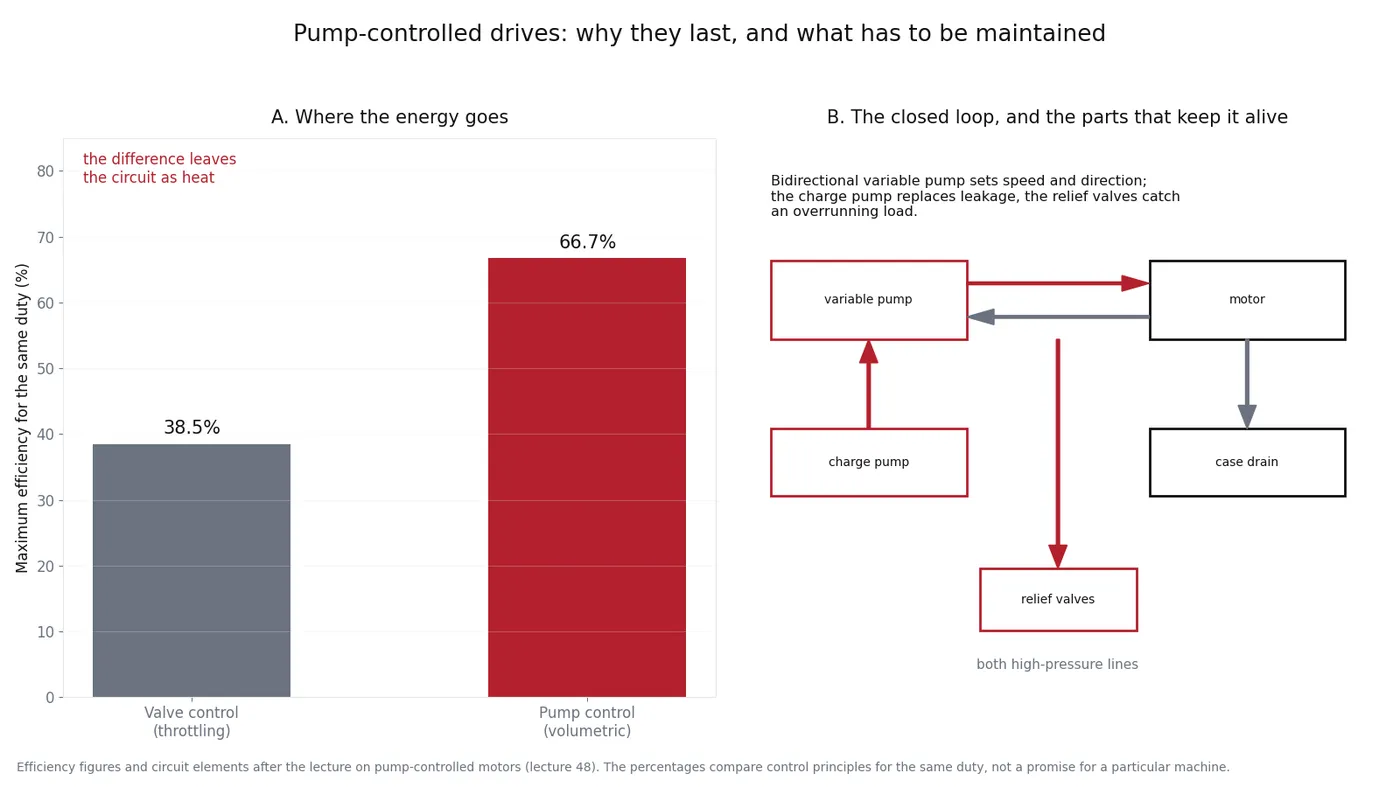
A work implement is valve-controlled: the pump supplies pressure, the valve meters flow, and the difference between supply and load pressure turns into heat. That is acceptable at low power. At the power level of a travel or swing drive it is not, so those functions are pump-controlled instead: the pump itself changes displacement, the loop is closed, and there is almost no throttling loss.
The course figures for the same duty put the comparison in perspective: a matched valve-controlled system peaks near 38% efficiency, while a volumetric (pump-controlled) drive reaches about 67%. The difference is the reason travel and swing last as long as they do - and the reason they have parts that the implement circuit does not.
Number 1: charge pressure
The charge pump keeps the low-pressure side of the closed loop full, so the unit never cavitates and the control mechanism always has oil to work with. It also continuously replaces internal leakage.
- How to measure: gauge on the charge circuit, oil hot, engine at working speed.
- Low reading means: a worn charge pump, a blocked suction filter, a leaking charge relief, or a case drain restriction. Symptoms are noise, loss of control downhill, and heat.
- Why it matters: this is the cheapest repair on the machine and the most common cause of an expensive one.
Number 2: case drain flow
Every piston unit leaks internally, and the leakage leaves through the case drain. It is the single most useful wear indicator on the machine.
- How to measure: hot, at working pressure, into a calibrated container for one minute; compare with specification.
- A steady rise over months is normal wear and gives you time to plan a repair.
- A sudden rise usually means contamination, a scored valve plate or a damaged slipper - and it is the moment to check the filter and the oil, not just the unit.
Number 3: control response
A pump-controlled drive changes speed by changing the swashplate angle, and that mechanism is a small servo of its own. Measure the command against the response: swashplate angle or control pressure against lever position, or machine speed against command on a flat, unloaded run.
- Slow or stepped response with good charge pressure points at the control servo, its filter, or the electrical signal driving it.
- Response that is fine cold and poor hot points at leakage or viscosity - check numbers 1 and 2 first.
The number people forget: cleanliness
Charge circuits contain small orifices and fine pilot filters, and the same contamination rules apply as anywhere else on the machine: roughly 20 µm filtration for a mobile proportional circuit, and a filter that is changed on evidence rather than on hope. A hydrostatic drive that fails early almost always has a filtration story behind it.
What kills these drives
| Cause | How it shows up | Prevention |
|---|---|---|
| Low charge pressure | Noise, poor control downhill, rising temperature | Filter and charge pump service, correct oil level |
| Contamination | Sudden case drain rise, scored valve plate, intermittent control | Filter discipline, flushing after any failure, clean fill |
| Overrunning loads with no relief path | Hose or seal failure, shock damage on downhill work | Correct relief and brake valve settings, accumulator condition |
| Wrong oil or water ingress | Viscosity changes, corrosion, erosion of the valve plate | Correct grade for the climate, oil sampling, breather service |
| Running to failure | Metal in the case drain, damage beyond a repair kit | Trend the case drain; repair while a kit is still enough |
Three readings, taken hot, once a season: charge pressure, case drain flow, and control response. They cost an hour a year and they are the difference between a repair kit and a new assembly. We supply both - travel and swing assemblies, charge pumps, rotating groups and seal kits - and we would rather quote you the kit.
Related reading: why a motor is not a cylinder, closed-circuit hydrostatic drives, and the case drain test.