
Noise is a measurement, not an opinion
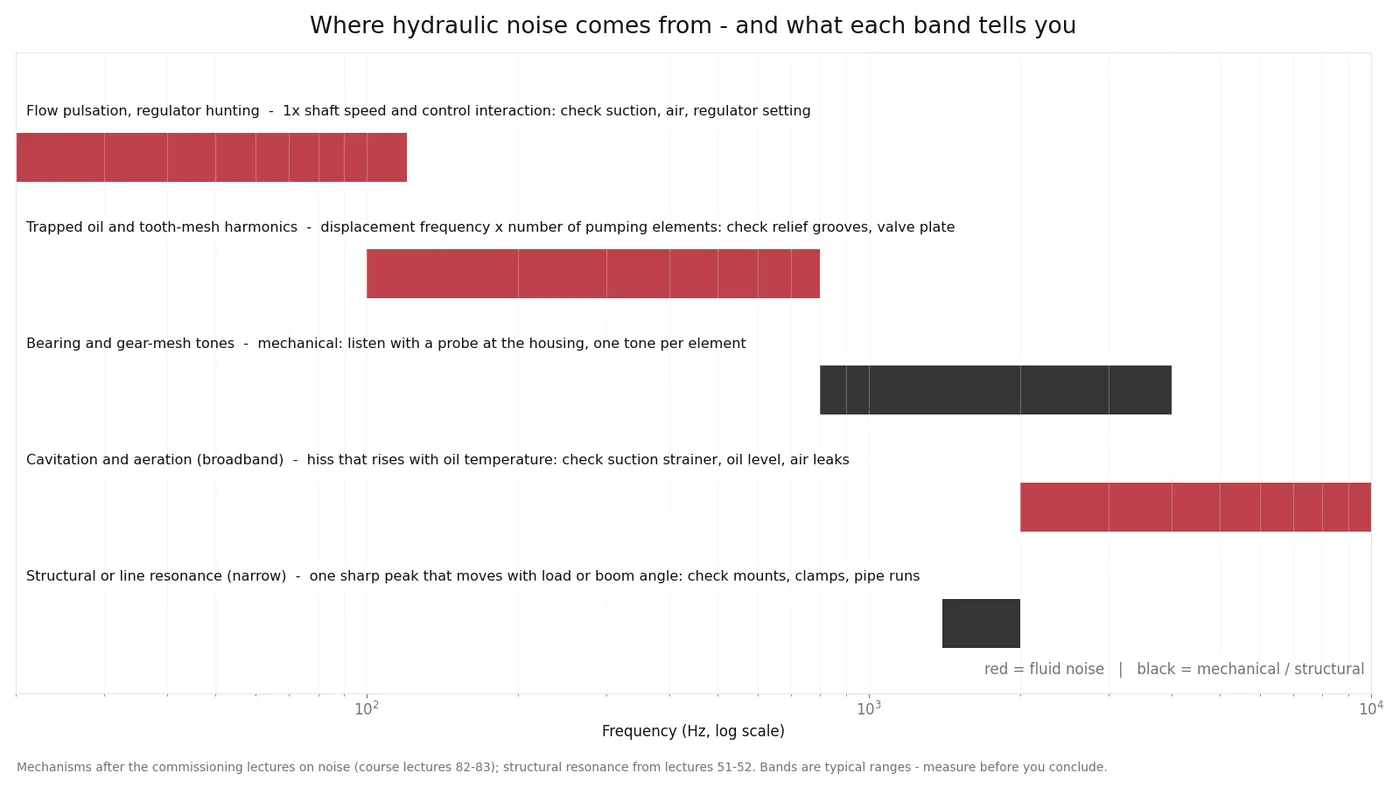
Sound is vibration that reaches your ear, and every hydraulic sound has a mechanism behind it. The useful question is never "is it loud", but "which band is it in" - because the band points at the component. Split the spectrum and most arguments about a "noisy pump" end in ten minutes.
Two families cover almost everything on an excavator. Fluid noise comes from the oil itself: cavitation, pressure pulsation and trapped oil. Mechanical noise comes from parts moving against each other: bearings, gear mesh and structural resonance. They occupy different frequency ranges, which is why a phone recording with a frequency readout beats a description over the phone.
Fluid noise: three mechanisms you can influence
- Flow pulsation. Every positive displacement pump delivers oil in pulses, at the pump frequency and its harmonics. It is structural to the design, but its level depends on the system: air in the oil amplifies it, and a regulator that hunts turns it into a beat you can hear.
- Trapped oil (the relief groove problem). Where the volumes between teeth, or between piston ports, close and then open again, oil is trapped and squeezed. The standard cure is a relief groove that connects the trapped volume to the pressure port on the high-pressure side and to the suction port on the low-pressure side. A wrong or blocked groove turns a quiet pump into a hammer.
- Cavitation and aeration. A starving suction side makes a broadband hiss that rises with temperature and speed. Air drawn in through a loose suction clamp, a low oil level or a collapsing suction hose makes a similar sound with a different cure: find the leak, do not slow the machine down.
Mechanical noise: what the pump cannot fix
Bearing tone and gear mesh appear as narrow tones, one per element. If the tone follows shaft speed, it is inside the unit. If it follows load or boom angle instead, suspect structure: a mount, a clamp, or a pipe run whose natural frequency is being excited.
This is where system stiffness matters. A servo or proportional circuit is stable only when structural stiffness, load stiffness and hydraulic stiffness are all adequate. Bolting a rebuilt pump onto worn rubber mounts lowers the first of the three, and the machine starts to shudder at one particular speed - a symptom people often misread as a pump fault.
Why piston pumps win the noise argument
Gear pumps have three classic noise sources: trapped oil, manufacturing error in the gears, and flow pulsation. The first two can be designed and manufactured away. The third cannot: pulsation is inherent to the geometry. That is one reason high-pressure machines use axial piston pumps such as the K3V and K5V series, whose multiple pistons overlap their delivery and leave far less ripple.
| What you hear | Where it sits | First check |
|---|---|---|
| Low rumble that tracks engine speed | Pump frequency and harmonics | Oil level, suction strainer, air leaks |
| Sharp hammering at one speed | Trapped oil or a resonance | Mounts and clamps, then relief groove and valve plate condition |
| Continuous hiss that grows when hot | High frequency broadband | Suction restriction, oil viscosity, water or air in the oil |
| One clear tone, load dependent | Mechanical | Probe the housing, check bearings and gear mesh |
The order to check after a repair
- Oil level and suction. A pump that was quiet on the bench and noisy in the machine usually starves on start-up.
- Air. Check suction clamps, the strainer seal and the tank breather. Aeration sounds like cavitation but the oil is clean.
- Settings. Relief and regulator settings from the machine specification. A pump running against a wrongly set relief is loud, hot, and short-lived.
- Mounts and pipe runs. Rubber mounts, clamps, and the length of unsupported pipe. Add a clamp before you replace a unit.
- Case drain and internal leakage. Measure it hot. If flow is high, noise is only the first symptom you will meet.
If the noise appeared with the new pump, the pump is still the last component to condemn. Suction, air and settings account for most "new pump is noisy" complaints we see, and all three are checked in under an hour.
Send us a recording plus the unit nameplate: machine model, pump model, and whether the noise changes with oil temperature is enough for us to narrow it down and quote the right internal parts if they are needed.
Related reading: pump noise and heat diagnosis, pilot stages explained, and the full diagnosis index.