
Correction is not optional
A hydraulic loop is not finished when the components are chosen. The design has to satisfy three requirements at once - stability, speed of response and accuracy - and no single adjustment delivers all three. Raising the gain improves speed of response, but the steady-state error grows with it. That is why real systems are compensated: correction raises the gain at low frequency (to cut steady-state error) or lowers it at high frequency (to keep the loop stable).
This is also the honest answer to "why can't I just turn the pressure up". You can turn it up; the loop will tell you what it thinks.
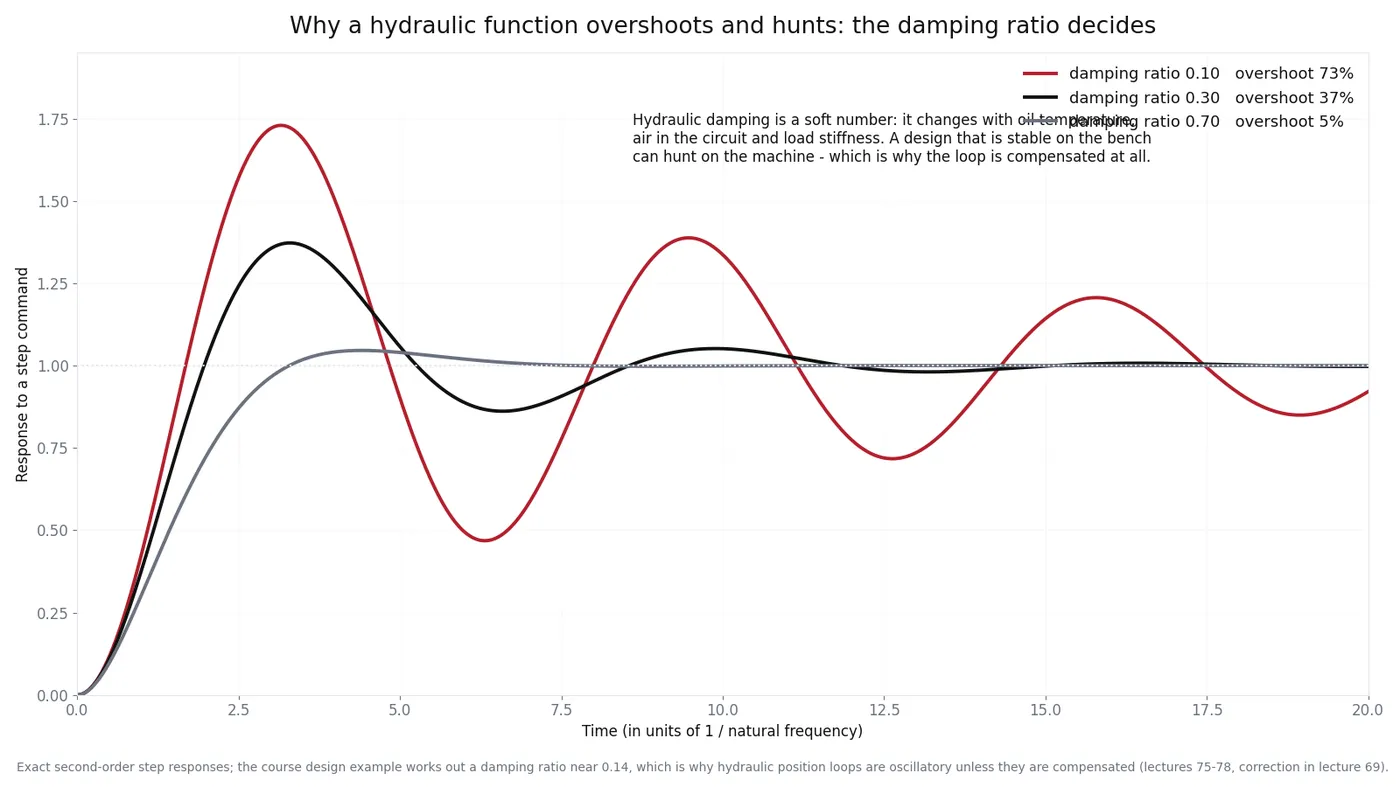
Why hydraulics is "soft"
In textbook control work the damping ratio is a fixed number. In hydraulics it is a range, and a wide one - it moves with oil temperature, with air in the circuit, with load stiffness and with the condition of the mounts. The worked design example in the course material lands near 0.14, comfortably in the oscillatory region, which is why hydraulic position loops are described as an integrating element plus a second-order oscillation.
Two practical statements follow. A machine that behaves on the bench can hunt on the machine. And a machine that hunts is not necessarily badly designed - it may simply be running at the edge of a number that moved.
What actually produces hunting in the field
- Air in the oil. Air is a spring with low stiffness, and it lowers damping. Foam in the tank, a loose suction clamp or a recent repair are the usual sources.
- Cold oil. Viscosity changes leakage and friction, so the loop that was tuned at 60 °C is a different loop at 10 °C.
- Structural stiffness. Long unsupported pipe runs, worn rubber mounts and flexible brackets reduce the stiffness the loop assumes. In severe cases a machine shudders at one particular speed.
- Damaged damping devices. Accumulators, damping orifices and dynamic-feedback arrangements exist to add damping; a flat accumulator removes it.
- Controller gains changed without measurement. A gain copied from another machine is a guess.
The four things an owner can change
- Warm the machine before precision work, and use the oil grade specified for the climate. This is the cheapest damping adjustment available.
- Remove the air: bleed after repairs, fix suction leaks, keep the tank level right, replace the breather.
- Restore the structure: replace mounts, add clamps, shorten unsupported spans - especially before replacing a pump that "made the machine vibrate".
- Test the damping devices: accumulator precharge, damping restrictors, and only then the controller gains, with a recorded step response so the change can be judged.
Force control is a different animal
The three controlled quantities in hydraulics are position, speed and force. Force systems are built differently: the valve is chosen to establish pressure by controlling the oil entering the cylinder chamber, and the loop closes on a force sensor rather than a position sensor. Because the feedback element changes, the transfer function changes, and tuning that works on a position loop usually will not work on a force loop. This is why tension control on a machine tool or a test rig is a specialist job, and why "the same valve, tuned the same way" is not a safe assumption.
What to send us
If a function overshoots, hunts or shudders, tell us the machine model, the pump nameplate, which function misbehaves, and whether it changes when the oil is hot. If you have a step response or a video, better still: the oscillation frequency alone usually narrows the cause to structure, air or tuning.
Related reading: measure before you replace, hydraulic noise diagnosis, and jerky or crawling motion.