
The force that pushes the spool closed
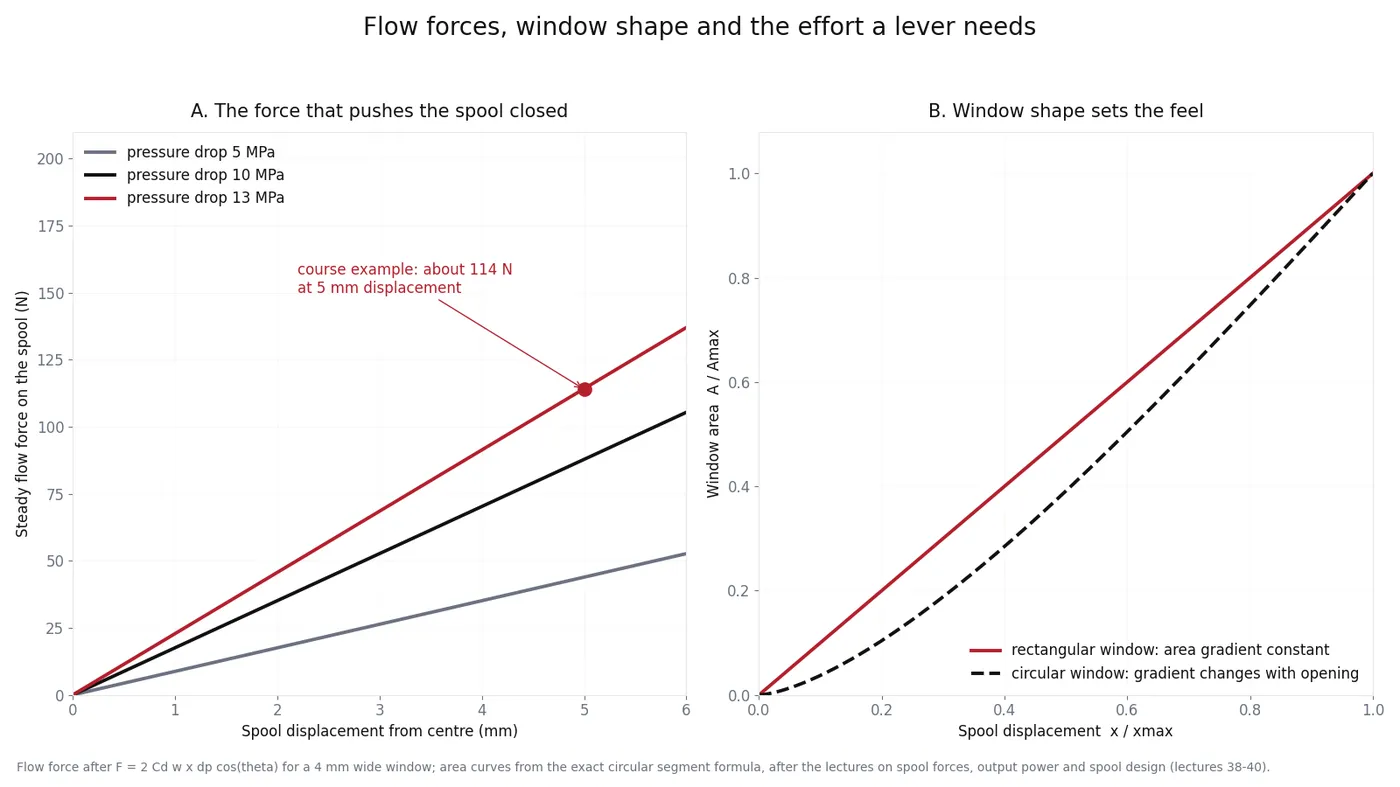
Oil leaving a metering edge changes direction, and the momentum change has to be paid for by the spool. The result is the steady flow force: proportional to the opening, to the pressure drop and to the width of the window, and always directed to close the valve.
Two practical consequences follow. It behaves like a hydraulic spring - which is good for stability, because it resists movement - but it also means the spool needs more force to move, and a machine with a larger flow or a higher pressure will always demand more effort or more pilot pressure at the same lever.
There is a second component you will meet as a symptom rather than a force: the transient flow force, proportional to the rate of change of the opening. It can drive a light spool into self-excited oscillation, which is one of the mechanisms behind a valve that whistles or chatters (see the companion article).
Why window shape changes how a machine feels
The window is the shape the spool land uncovers as it moves. A rectangular window keeps the area gradient constant, so flow and spool position are linearly related - predictable and easy to control. A circular window is easier to machine but its gradient changes with opening, so the first part of the lever travel does little and the last part does a lot. Modern designs accept the non-linearity because the electronics can compensate it; a hydromechanical machine cannot, and that is where "this lever is notchy" comes from.
Where the effort and the heat come from
The same analysis that gives the flow force also gives the power limit: the maximum output power of a matched zero-lapped four-way valve occurs at two thirds of supply pressure, and that single number explains two things an owner can see.
| Observation | What is happening | What it means |
|---|---|---|
| Levers feel heavy on a high-flow machine | Flow force scales with window width and pressure drop | Pilot-operated controls are not a luxury; they are what makes the lever effort independent of flow |
| Oil overheats on an older machine | The duty point sits far from the two-thirds point, so most flow is spilled at relief pressure | Check the relief setting and the duty: raising pressure does not add work, it adds heat |
| Fuel consumption is high while working slowly | Fixed-pump throttling control peaks near 38.5% efficiency for the duty | Load sensing or a pump-controlled function is the upgrade path - it reaches roughly 66.7% |
| Function is fast and stiff but hot | Direct consequence of throttle control: responsiveness is bought with energy | Correct for the duty; servo systems deliberately trade efficiency for performance |
The one rule worth remembering
The design rule that follows from the power calculation is compact: supply pressure should be about 1.5 times the load pressure. That puts the operating point at the two-thirds position where the valve delivers maximum power. Set the supply far above the load and the difference is not stored anywhere - it leaves as temperature, in the oil and in the cooler.
So when a machine is "slow and hot", the honest first question is not which component is worn, but where the duty point is. We can usually answer it from three numbers: the relief setting, the working pressure under load, and how long it takes the oil to reach 70 °C.
What to send us
Machine model, pump nameplate, the function you are unhappy with, and those three numbers if you have them. If the verdict is a valve or a pump, the part number and the window/lap variant is what decides the replacement - and a spool with the wrong window shape will make a correct pump feel wrong.
Related reading: why a valve whistles, flow gain and load matching, and throttling or displacement control.