
Every litre of oil you do not use becomes heat
A conventional excavator controls speed by throttling: the pump delivers flow, the control valve restricts it, and the surplus pressure drop turns into temperature. The same machine with load-sensing or negative-flow control reduces pump displacement instead, so less oil is generated in the first place. The difference in energy is not a marketing claim - it follows from the geometry of the valve and can be written as a single curve.
The number the textbook gives
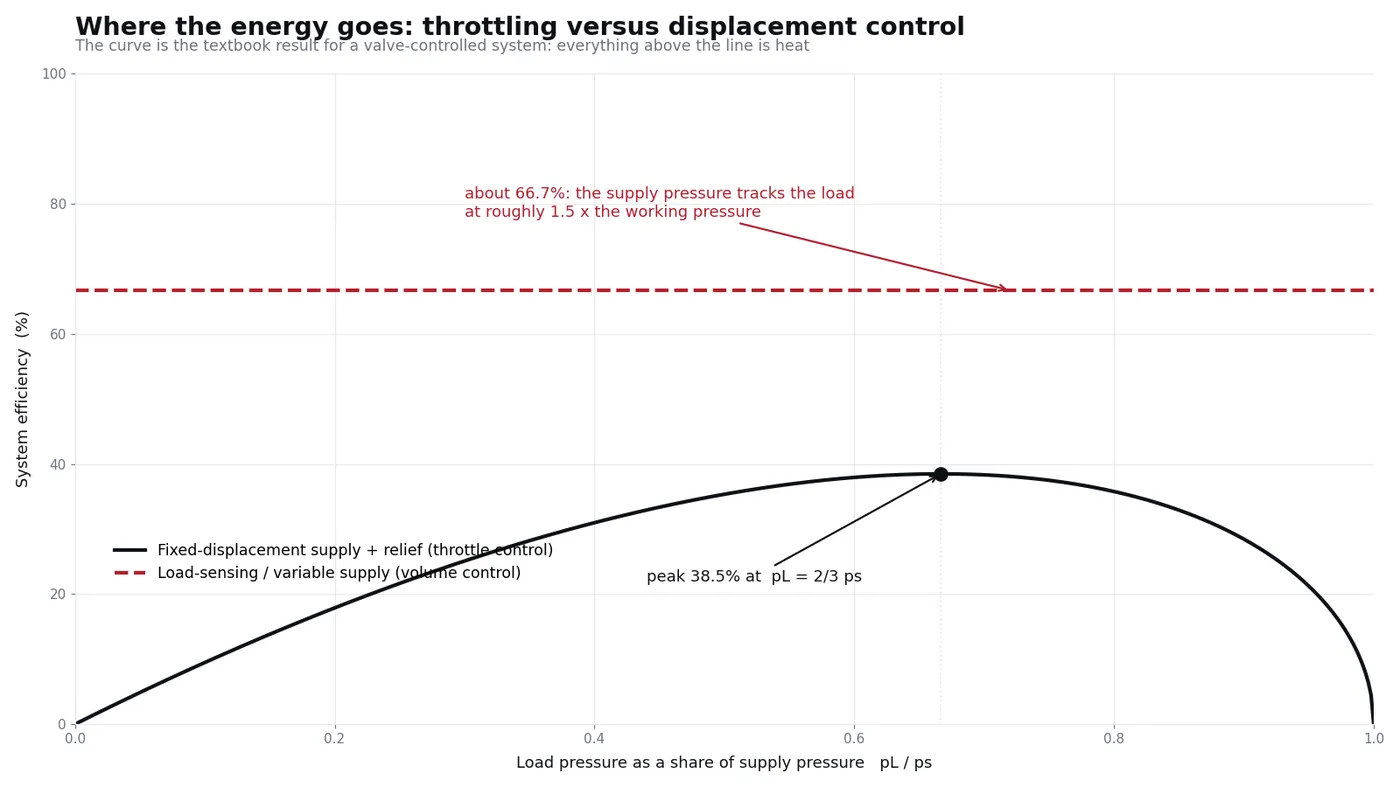
For a valve-controlled system the output power is simply load pressure times load flow. Working through the valve equation shows the maximum lands at a load pressure of about two thirds of the supply pressure. What happens to the rest depends entirely on how the oil is supplied:
- Fixed-displacement pump with a relief valve - the pump always delivers its full flow, and whatever the machine does not use is dumped over the relief. Peak efficiency is only about 38.5%, and it occurs at the same two-thirds point.
- Variable-displacement pump (volume control, load sensing) - the pump delivers only what is asked for, and the supply pressure tracks the load. Efficiency reaches about 66.7%.
The 1.5 rule worth remembering
The two-thirds point translates into a practical rule: if you want the system to run cool and use less fuel, the supply pressure should sit at roughly 1.5 times the load pressure the machine actually works at. Set it much higher and you are paying for pressure the work never uses - in fuel, in oil temperature and eventually in seal life. Set it lower and the machine cannot develop full force or full speed when it needs to.
| Control principle | How flow is set | Response | Energy | Where you see it |
|---|---|---|---|---|
| Throttle (meter-out / meter-in) | Valve opening restricts a constant pump flow | Fast, stiff | Poor: surplus leaves as heat | Older machines, simple attachments |
| Negative flow control | Valve centre signal reduces pump displacement as the lever returns | Fast | Better; idle flow is cut back | Most modern excavator main pumps |
| Load sensing / positive control | Pump delivers the flow the open section asks for, at a fixed margin above load | Fast, accurate | Best of the three | Modern excavators, cranes, drilling rigs |
| Volume (displacement) control | Pump displacement alone sets speed; no metering valve | Slower | Highest hydraulic efficiency | Travel drives, winches, industrial drives |
What this means in the workshop
- Oil overheating is often a control problem, not a cooler problem. If the machine is running with the relief open, or the regulator is not reducing displacement when the levers are centred, no amount of cooler capacity will fix it.
- A stuck regulator costs fuel every hour. Check standby pressure and regulator stroke before assuming the pump is worn.
- Do not raise the relief setting to "make it stronger". Above the two-thirds point the system gets less efficient and every extra bar becomes heat; if the machine lacks force, the fault is elsewhere.
- Matching matters more than headline displacement. A pump whose displacement is larger than the work requires simply throttles more oil and runs hotter.
Related field guides: oil overheating, engine bogging down under load and all functions slow. Catalogue figures for each displacement class are on the specification sheet.
Diagram drawn by our own team from the standard valve-controlled system derivation (peak efficiency 2/(3 sqrt 3) with a fixed-displacement supply, and the two-thirds load-pressure point). Technical principles referenced from the public course “Hydraulic Servo and Proportional Control Systems” (Yanshan University).