
The sentence that explains most "weak machine" complaints
A proportional or servo valve is a variable orifice. The electrical command moves the spool and sets an opening; the flow that follows depends on the pressure difference across that opening. Mainstream practice in industry is exactly this: the current controls the opening, not the flow. Closing the loop on flow itself is difficult and expensive, which is why manufacturers rarely do it.
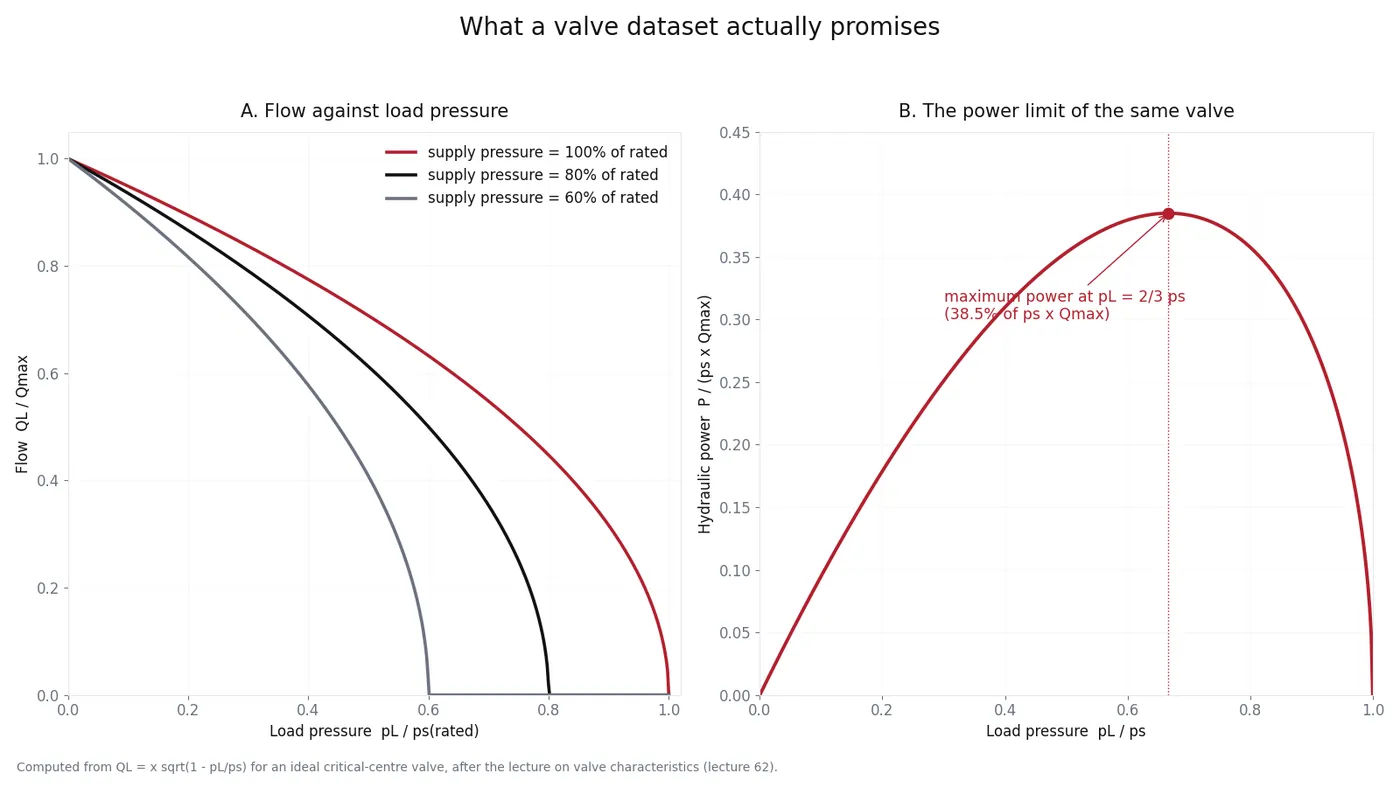
Two consequences land directly on the operator's seat. First, speed falls as the load rises, because a bigger load consumes a bigger share of the supply pressure and leaves less to push oil through the same opening. Second, the same machine behaves differently at different supply pressures - a tired pump, a wrongly set relief or a hot engine all move the curve down.
What the datasheet actually gives you
Valve characteristics come in three groups: static, dynamic and input. The static group is the one worth reading before a purchase, and it contains three curves:
- Load flow characteristic - flow against load pressure at a fixed opening. This is the curve in the figure above, and the one that tells you whether the valve can move your load at all.
- No-load flow-pressure characteristic - how delivery behaves against supply pressure.
- Internal leakage - the oil that crosses the spool clearance without doing work. It rises with pressure, and it is the reason a worn valve gets hot and slow at the same time.
The way these curves are drawn matters: load pressure over supply pressure, load flow over rated flow. Dimensionless curves let you compare valves of different sizes, and they show that maximum hydraulic power sits at about two thirds of supply pressure. That is why buying a larger displacement pump does not automatically make a machine stronger - the limit is the valve, not the pump.
Why the same machine feels different on a cold morning
Leakage depends on viscosity, and viscosity depends on temperature. A warm machine leaks more past a worn spool and delivers less to the function; a cold machine has thicker oil, higher line losses and a different feel again. When an operator says "it is fine in the morning and weak after lunch", that sentence is already a diagnosis: you are looking at clearances, temperature and oil condition, not at a sudden electrical fault.
What an owner can measure without a flow bench
| Complaint | Measurement | What it tells you |
|---|---|---|
| One function slow, others fine | Cycle times of boom, arm, bucket, swing, travel | Isolates the function: valve, cylinder or pilot line rather than the pump |
| Everything slow when hot | Case drain flow and standby pressure, both hot | Pump wear or regulator drift, not a valve |
| Speed falls as the load rises | Pressure at the function while stalling it against relief | Normal behaviour if the pressure is within specification |
| Function drifts when the lever is centred | Return flow at the valve with the spool centred | Internal leakage in the spool or a worn cylinder seal |
| Sluggish first movement of the day | Oil temperature and pilot pressure | Viscosity and pilot supply, not the main valve |
When it really is the valve
Three findings point at the valve rather than the pump: leakage that appears only when hot, a spool that sticks or steps instead of moving smoothly, and a function that changes behaviour after a filter or oil change. All three are about clearance and contamination, and the cheapest response is a filter, an oil sample and a flush before anyone opens the valve.
If a replacement is needed, send us the valve nameplate plus the machine model and the pump model. K3V and K5V regulators are matched to the pump they sit on, and the suffix on the pump nameplate is what identifies the correct control variant.
Related reading: flow gain and load matching, spool lap and metering, and the diagnosis index.