
Three mechanisms, three different noises
Operators describe all of them as "whistling". They are not the same fault, and they do not have the same cure.
- Cavitation at the metering edge. Every metering edge converts pressure into velocity. Push 30 MPa across a small opening and the jet leaves at well over 100 m/s - far past the point where the local pressure drops below the vapour pressure of the oil. The result is a high-pitched scream with erosion of the very edge that is doing the metering.
- Self-excited oscillation. The transient component of the flow force is proportional to the velocity of the spool, and it can make a light, high-gain spool unstable. It sings on its own, without any external excitation, in a narrow band around one operating point.
- System resonance. The valve, the oil trapped between the valve and the actuator, and the line form a spring-mass system. Change the hose length, add an accumulator, or move the valve, and the note changes - which is the giveaway.
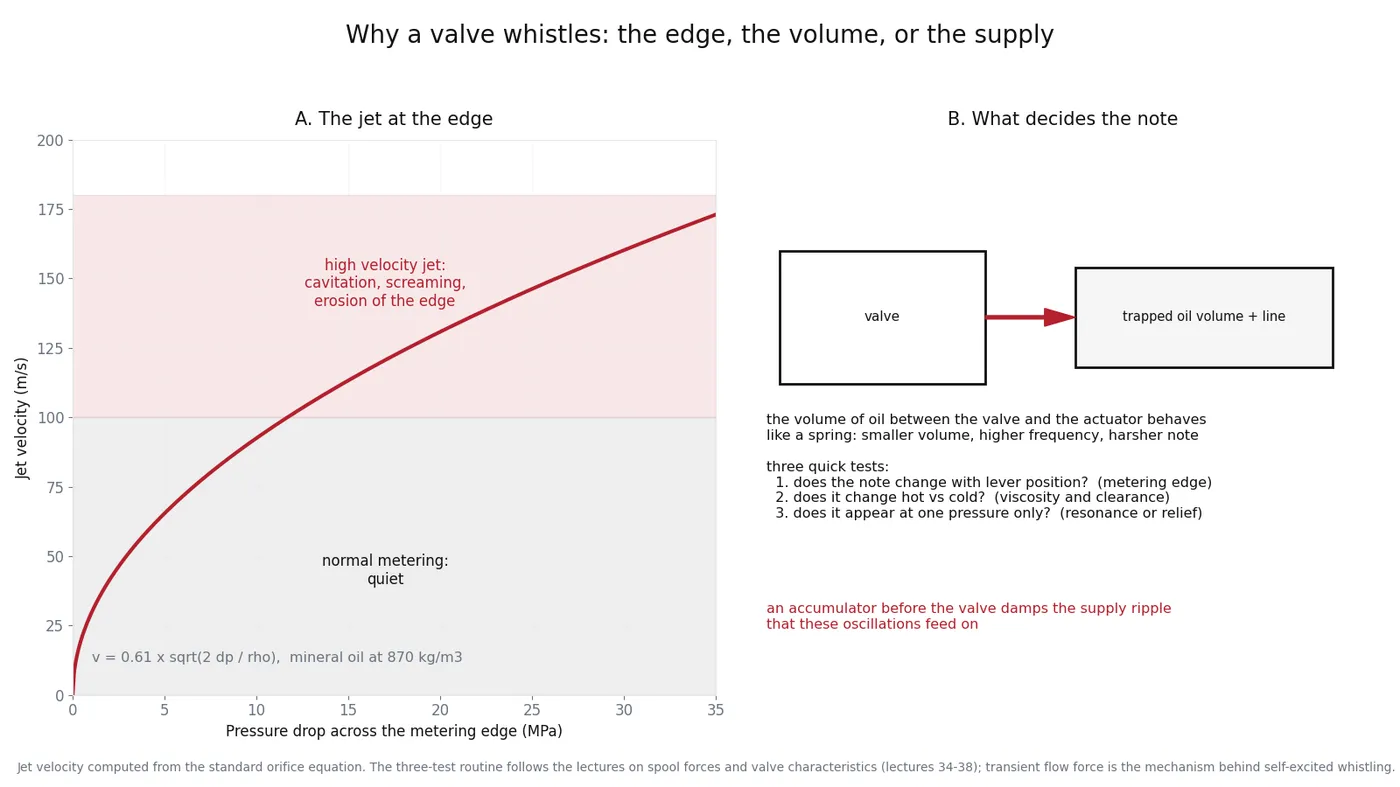
The three tests
| Test | If the noise changes... | Suspect |
|---|---|---|
| Move the lever slightly | Note appears only in a narrow band of spool positions | Cavitation at a small opening, or an unstable operating point |
| Compare cold and hot | Worse when hot; changes with oil temperature | Clearance, viscosity, leakage: a worn or distorted edge |
| Watch the pressure gauge | Appears at one particular pressure, repeats every cycle | Resonance, or a relief/compensator valve oscillating with the circuit |
What the textbook assumptions tell you to check
Valve behaviour is described under four assumptions: a constant-pressure supply, negligible losses in pipes and valve, incompressible oil, and equal discharge coefficients at the four edges. Every one of those assumptions can be violated on a real machine - and each violation shows up as noise or instability.
- The supply is not constant. That is why an accumulator is fitted before a servo valve: to absorb the pressure ripple that an oscillating valve feeds on.
- The oil is not incompressible. Trapped volume behaves like a spring, and the smaller the volume, the higher the stiffness and the sharper the note.
- The edges are not equal. Wear, erosion and dirt change the area gradients differently on each edge, and an asymmetric bridge pushes the spool off centre.
What an owner can do
- Stop holding the machine at the screaming point. If the noise occurs only at one lever position, the edge is being eroded every hour it spends there.
- Bring the supply pressure back to specification. Higher pressure means higher jet velocity; a relief that has drifted upwards makes the same valve noisier and hotter.
- Check the accumulator - precharge and charging circuit. It exists to damp exactly this kind of pressure ripple.
- Fix the filtration and flush before condemning the valve: contamination both erodes edges and jams spools.
If the whistle is accompanied by a slow or jerky function, send a video with the machine model and the valve part number. The pitch, the lever position and the oil temperature usually identify which of the three mechanisms you are hearing, and that decides whether this is a filter, an accumulator or a valve.
Related reading: hydraulic noise diagnosis, flow forces and heavy levers, and pump noise and heat.