
Four choices define a spool
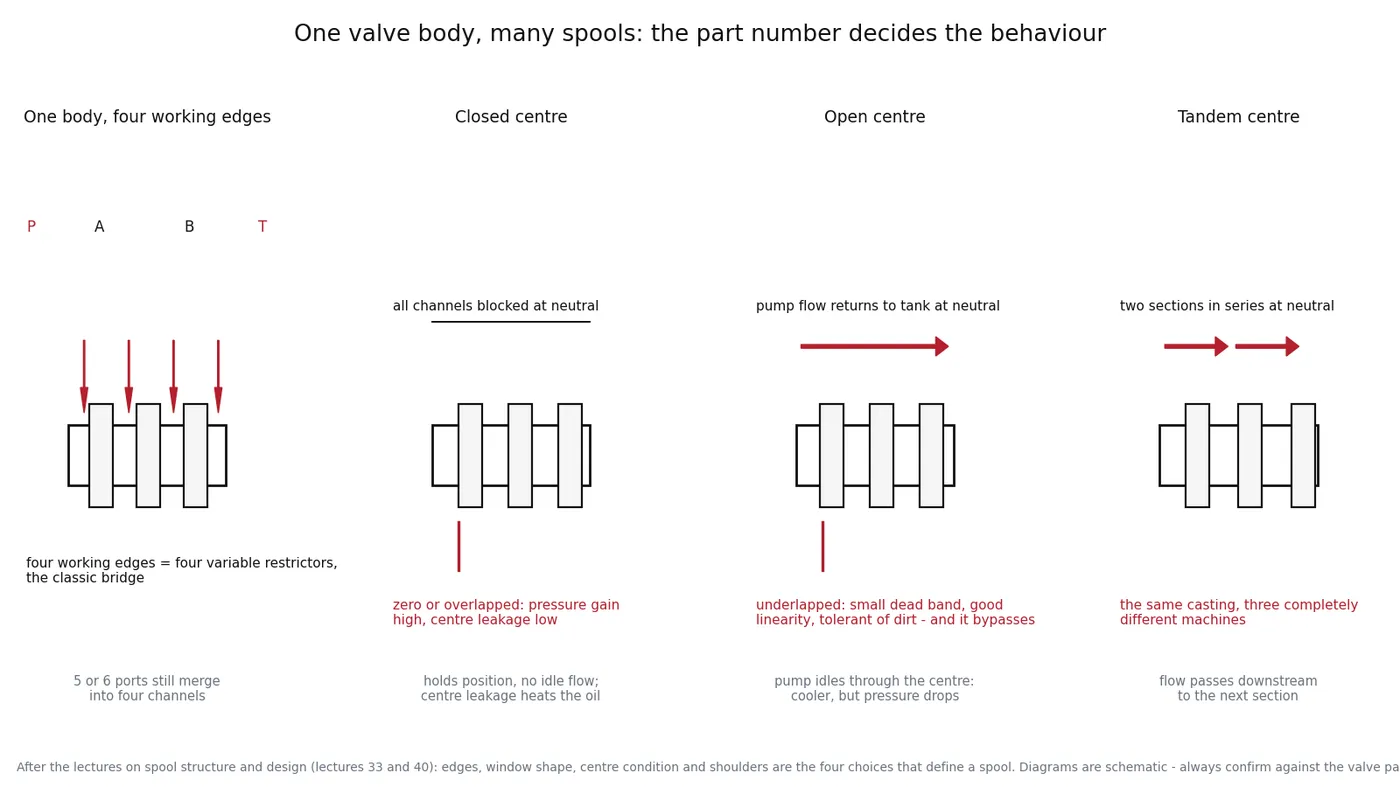
A directional valve is two parts: the spool and the sleeve. Everything that matters is in how the spool lands line up with the sleeve ports, and the designer makes four decisions:
- How many working edges - two edges for a differential or single-acting function, four edges where the actuator must move equally and controllably in both directions.
- The window shape - rectangular for a constant area gradient and linear metering, circular for easier machining with an intentionally non-linear feel.
- The centre condition - closed, open or tandem, and how much overlap or underlap sits at the centre.
- The shoulders - the grooves and auxiliaries that keep the spool from locking in its bore.
Change any one of them and you have a different machine, in a casting that looks identical.
What each choice does to the operator
| Choice | One way | The other way |
|---|---|---|
| Centre condition | Closed centre: holds position, no idle flow, high pressure gain, least dirt tolerance | Open centre: pump flow circulates at neutral (cooler, quieter), small dead band, good linearity, but pressure drops when other functions work |
| Lap at centre | Zero lap: sharpest response, best accuracy, hardest to manufacture | Underlap: smooth and dirt-tolerant, but it bypasses and heats the oil |
| Window shape | Rectangular: linear flow against lever travel | Circular: non-linear - fine with electronics, awkward for a manual machine |
| Shoulders | With grooves: low side force, smooth action for years | Without: cheaper, and prone to sticking as pressure and temperature rise |
Port count will not tell you which one you have
A valve body may show five or six ports on its base plate and still be a four-way valve, because the return ports are merged inside. Judging by the number of connections on the outside, or by the shape of the casting, is how the wrong spool gets ordered. The classification that matters is by effective channels and working edges, and it is written in the part number.
Before you order a spool, a valve section or a pump regulator
- The valve part number from the nameplate - not the casting number, and not a photograph of the body.
- The machine model and the function - boom, arm, bucket, swing, travel, or the pump regulator.
- The behaviour you want - for example, "it creeps at neutral" or "it slams when I release the lever". Those two sentences point at opposite ends of the centre-condition table.
- The symptom history - when it changed, and whether anything was replaced before it did.
If we can identify the original part number, we can usually supply the correct spool or section; if the machine has been modified, we will say so rather than supply a spool that fits and misbehaves. That is the difference between a parts supplier and a catalogue.
Related reading: why a spool sticks, spool lap and metering, and the parts library.