
The cylinder decides, not the valve
A single-rod cylinder has two different working areas: the full bore on the piston side, and the annulus (bore minus rod) on the rod side. Every consequence follows from that one fact.
- Same pump flow, different speed. To move the rod a given distance, the rod side needs less oil. Retract is therefore faster, in proportion to the area ratio.
- Same load, different pressure. The rod side has less area to work with, so pushing the same force needs more pressure - and the relief setting is what limits it.
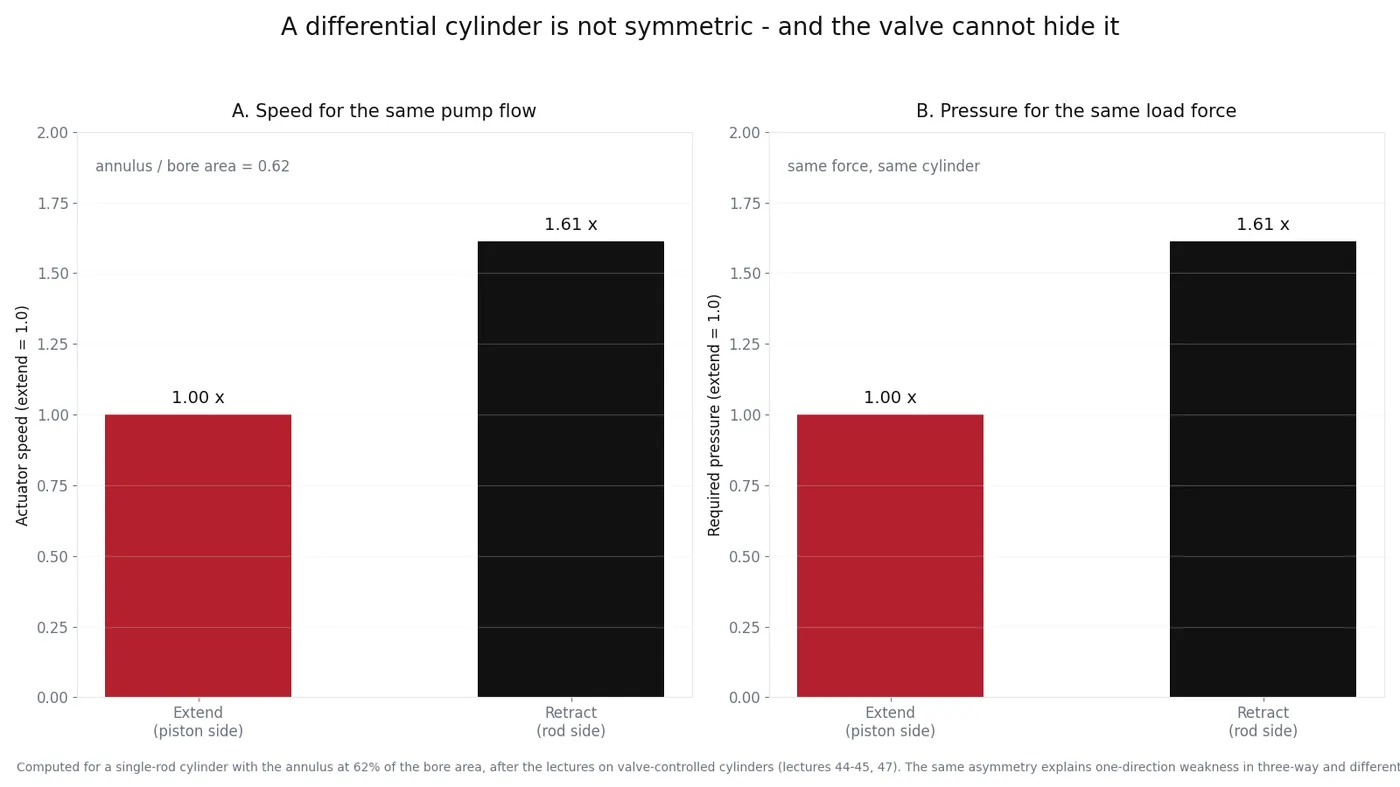
This is why "the same valve" produces two different machines. It is also why the classic complaint - it lifts fine but will not push, or one direction is slow - is often geometry rather than a fault.
Two-edge, three-way, four-way: what the circuit can and cannot do
The number of working edges on a spool is chosen from what the actuator needs. A differential or single-acting function only needs two edges; a symmetric actuator that must move equally in both directions needs four. The performance difference is worth remembering: the zero-position flow gain is the same, but the pressure gain of a two-edge valve is half that of a four-edge valve. Where accuracy and stiffness matter, four edges win; where cost and simplicity matter, two edges are enough.
Three-way control is the special case used in profiling machines and hydraulic boosters: a differential cylinder with one controlled chamber, the rod side held at supply pressure. Both working edges take part, and the flow relations look like the four-way equations but over a different range. The practical signature of these circuits is exactly the asymmetry: normal in one direction, weak or uncontrollable in the other.
Why "it felt different after the repair"
The dynamic behaviour of a valve-controlled cylinder is set by four things: the valve coefficients (which depend on the area gradient of the spool windows), the cylinder area, the volume of oil trapped between valve and cylinder, and the mass of the load. The natural frequency and the damping ratio are built from those four, which is why:
- fitting a valve with a different area gradient changes how sharply the function starts and stops;
- changing a hose length or a fitting kit changes the oil volume, and therefore the stiffness of the "spring" the loop works against;
- a heavier bucket or a longer boom changes the load, and the same settings now feel softer.
None of that is imagination. It is the same model that tells a designer why the loop needs compensation - and it is why we ask for the machine model, not just the pump nameplate, when a customer reports a behaviour change.
What to measure when one direction is weak
| Symptom | First checks | What the reading means |
|---|---|---|
| Retract slow, extend normal | Relief setting, pilot pressure, the rod-side line and fittings | A restriction in the smaller-area path, or a metering difference in the spool |
| Extend weak, retract normal | Main relief, regeneration circuit, holding valve | Pressure limit, or a holding valve not opening fully |
| Both directions slow when hot | Case drain flow and standby pressure, hot | Pump wear or regulator drift rather than the cylinder |
| Function drifts when centred | Return flow at the valve, rod seal condition | Internal leakage in the spool or the piston seal |
| New roughness after a repair | Trapped-oil volume (hoses, fittings) and valve part number | Different area gradient or oil volume: dynamics changed |
What we need to quote the right part
For cylinders and seal kits: bore, rod diameter, stroke and mounting. For the valve or the pump: the nameplate, the machine model, and which direction misbehaves. Those five items decide the part, and the area ratio in the first paragraph is what turns a vague complaint into a part number.
Related reading: the valve controls an opening, not a flow, spool lap and metering, and boom or arm drift.