
Matching is one equation
Hydraulic power is pressure multiplied by flow; the load wants force multiplied by speed (or torque multiplied by angular velocity). Matching the two is the whole of the exercise, and it is the reason the engineering literature now talks about energy as the limiting factor: performance can always be improved by raising the gain of the valve, but the price is a system that spends its life at high pressure and low flow - generating heat instead of doing work.
The envelope and the duty point
Draw the actuator's capability as a rectangle. Speed to the right is limited by the flow the pump can deliver; force upwards is limited by the pressure the relief allows multiplied by the working area. Any useful duty is a curve inside that rectangle, and where the curve crosses the envelope is the duty point.
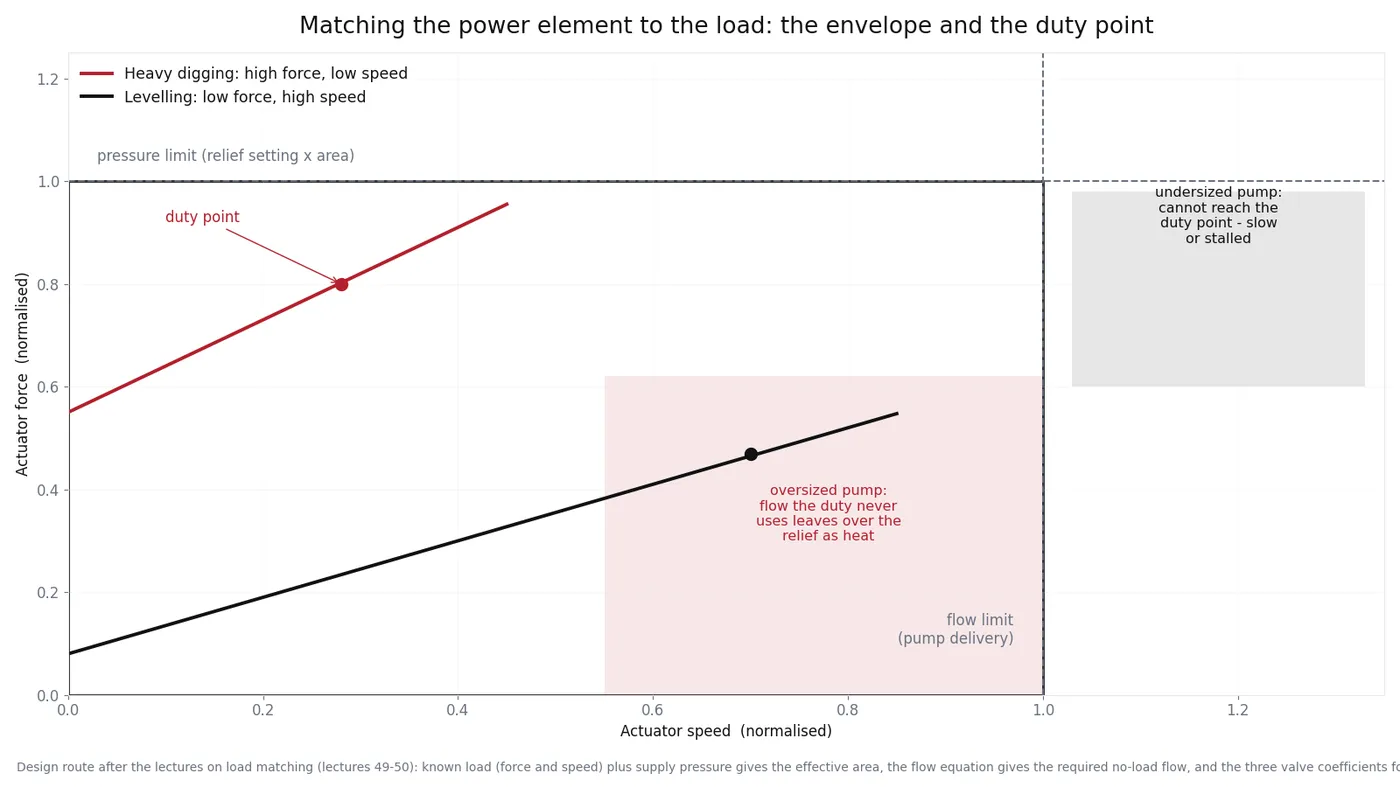
Oversized, undersized, and what each looks like in the field
| Machine | What the operator notices | What the gauges show |
|---|---|---|
| Matched | Full function speed at working pressure; oil temperature stable | Pressure near the relief only in the hardest duty; cycle time meets specification |
| Oversized pump | Fast when empty, no faster when digging; oil gets hot | Flow above the duty requirement; relief open for much of the cycle; high tank temperature |
| Undersized pump | Slow everywhere, worse under load, engine may lug | Pressure at relief, delivery below specification, slow cycle times |
| Wrong valve, right pump | Jerky or slow only at the start of the movement | Flow gain too high or too low for the actuator: look at the spool area gradient |
The most common expensive mistake is not a worn part. It is a machine that was matched for one duty - say, light trenching - and is now asked to do another with a heavier attachment.
The design route, in five steps
- Fix the load. Force and speed for each duty, from the machine specification - not from the biggest number anyone remembers.
- Fix the supply pressure. Working pressure, not the relief setting, is what the calculation uses.
- Get the effective area from force and pressure, then check the resulting speed against the flow available.
- Size the valve from the flow equation: the maximum no-load flow the actuator needs sets the maximum opening area.
- Check the three coefficients - flow gain, pressure gain and pressure-flow coefficient - against the actuator gain. A "small horse pulling a big cart" and the reverse are both bad, and the area gradient is the practical adjustment.
Changing a part changes the match
The dynamic behaviour of the power element - the natural frequency and the damping ratio - is built from the valve coefficients (area gradient), the actuator area, the volume of oil between valve and actuator, and the load mass. That has two consequences worth remembering on a service call:
- Fitting a valve with a different area gradient, or changing the pipe volume, changes how the function feels. It is not a superstition.
- Raising the relief pressure slightly, or fitting a heavier attachment, moves the duty point on both axes at once.
What an owner can measure
You do not need a design package to tell whether a machine is matched. Cycle time, working pressure at the duty point (not at the relief), and oil temperature after an hour of work are enough to see which of the four rows in the table above describes the machine. If oil temperature climbs while the work rate does not, the excess is going over the relief - a symptom page and a pump nameplate will usually tell us what the machine was built for.
Related reading: flow gain and load matching, throttling or displacement control, and engine stalls under load.