
Why a spool valve matters to a pump buyer
Every K3V, K5V and M5X unit we supply is controlled by a small spool valve inside its regulator: the spool senses control pressure and moves to change the swash plate angle. The control valve bank on the machine is a set of larger spool valves of the same family. In both cases the oil does not flow because a number is written on the nameplate - it flows because a spool moved a few tenths of a millimetre and opened a gap.
That gap is the subject of this article. Two valves can share a body, a spool diameter and a part number prefix and still behave differently, because the geometry of the edges - the lap - decides whether the machine feels crisp, sluggish, or simply will not hold a load.
The anatomy: spool, sleeve, lands and working edges
A spool valve is a spool sliding inside a sleeve. The raised sections of the spool are called lands (or shoulders); the sleeve has ports drilled into it. Oil passes only where a land edge uncovers a sleeve port, and the opening between them is the metering orifice. Its area grows with spool displacement, and that single relationship - area against displacement - is what converts a small mechanical input into a controlled flow.
Because the input signal is tiny and the controlled power is large, this class of component is called a hydraulic amplifier. A regulator spool that moves a couple of millimetres sets the output of a pump that moves hundreds of litres per minute.
How many passages does the spool control?
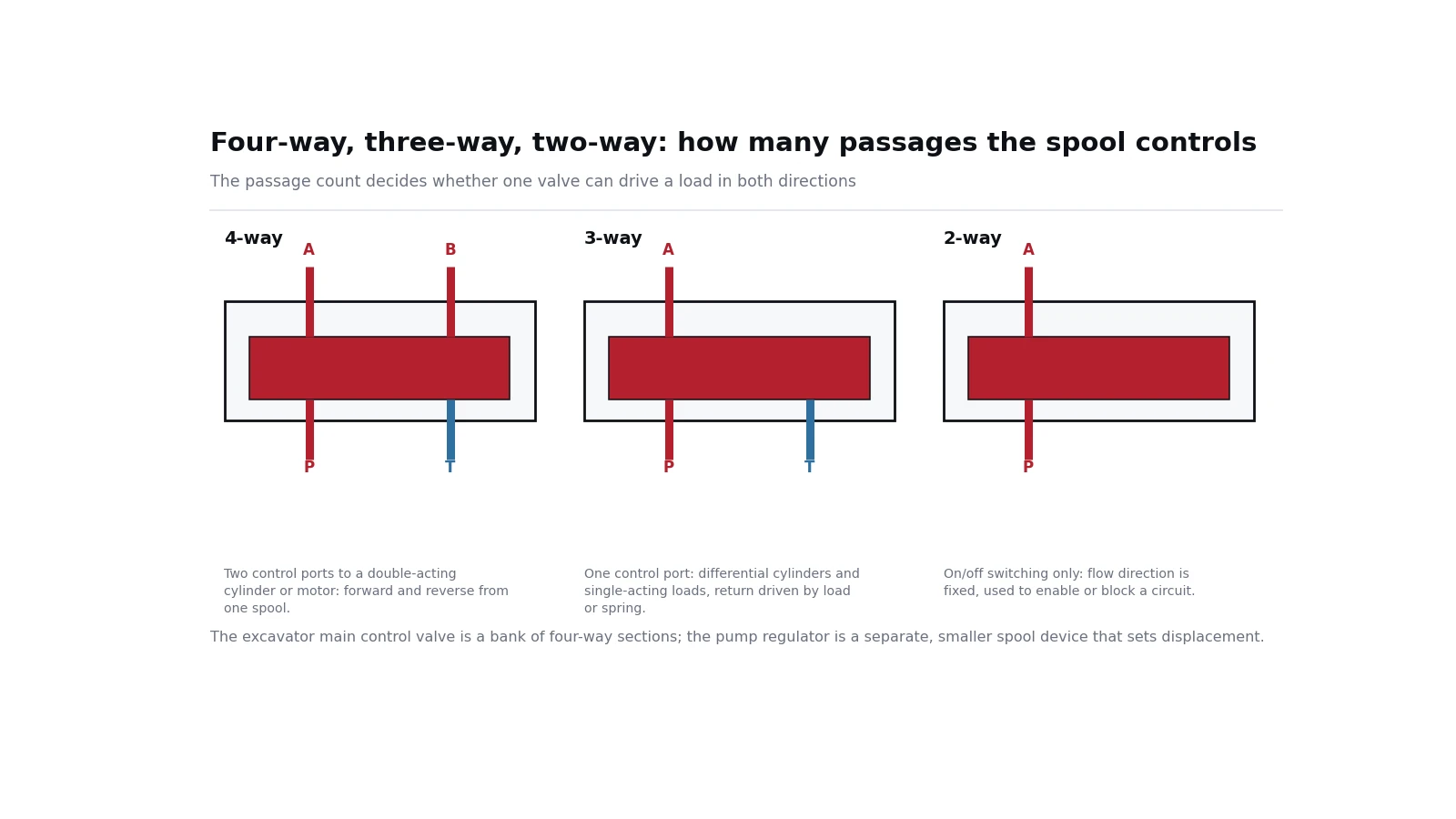
A four-way valve has two control ports and can drive a cylinder or motor in both directions - this is what the sections of an excavator control valve are. A three-way valve has one control port and suits differential cylinders and single-acting loads. A two-way valve only switches flow on or off. When a machine loses one direction only, the passage layout is the first thing worth understanding, because the fault is usually in the half of the circuit that is affected.
Lap: the detail that decides behaviour at neutral
Lap describes how the spool shoulder and the sleeve edge line up when the valve is centred.
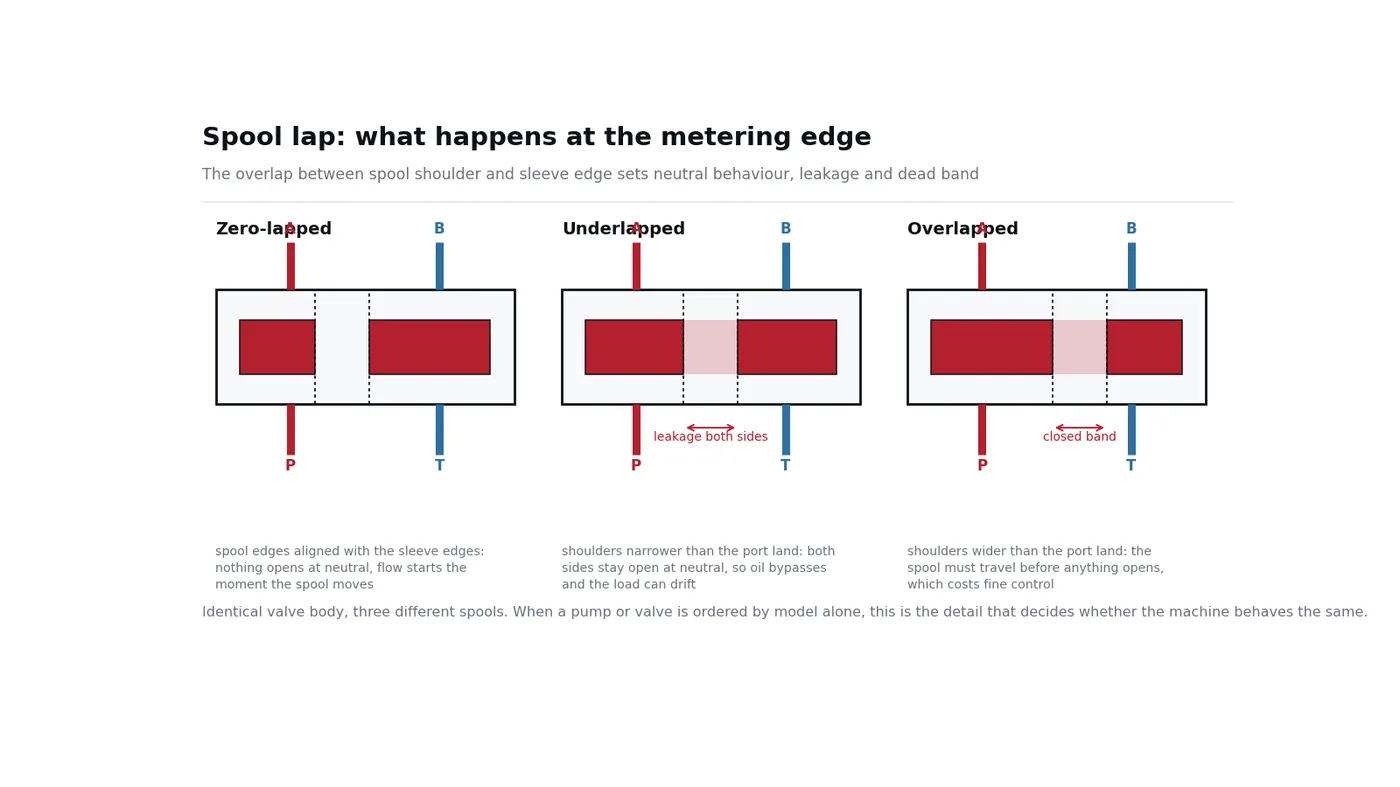
| Lap | At neutral | What the operator feels | Service consequence |
|---|---|---|---|
| Zero-lapped | Edges aligned, opening starts immediately | Sharp, proportional response with no lost travel | Most sensitive to contamination; the edge is the part that wears first |
| Underlapped | Both sides slightly open | Smooth, but the load can creep and the circuit runs warm | Neutral bypass heats the oil; drift is normal for the design, not a fault in itself |
| Overlapped | Both sides closed, a dead band exists | A small movement does nothing, then flow arrives | Holds load well, but fine control and repeatability suffer |
What the metering area curve tells a technician
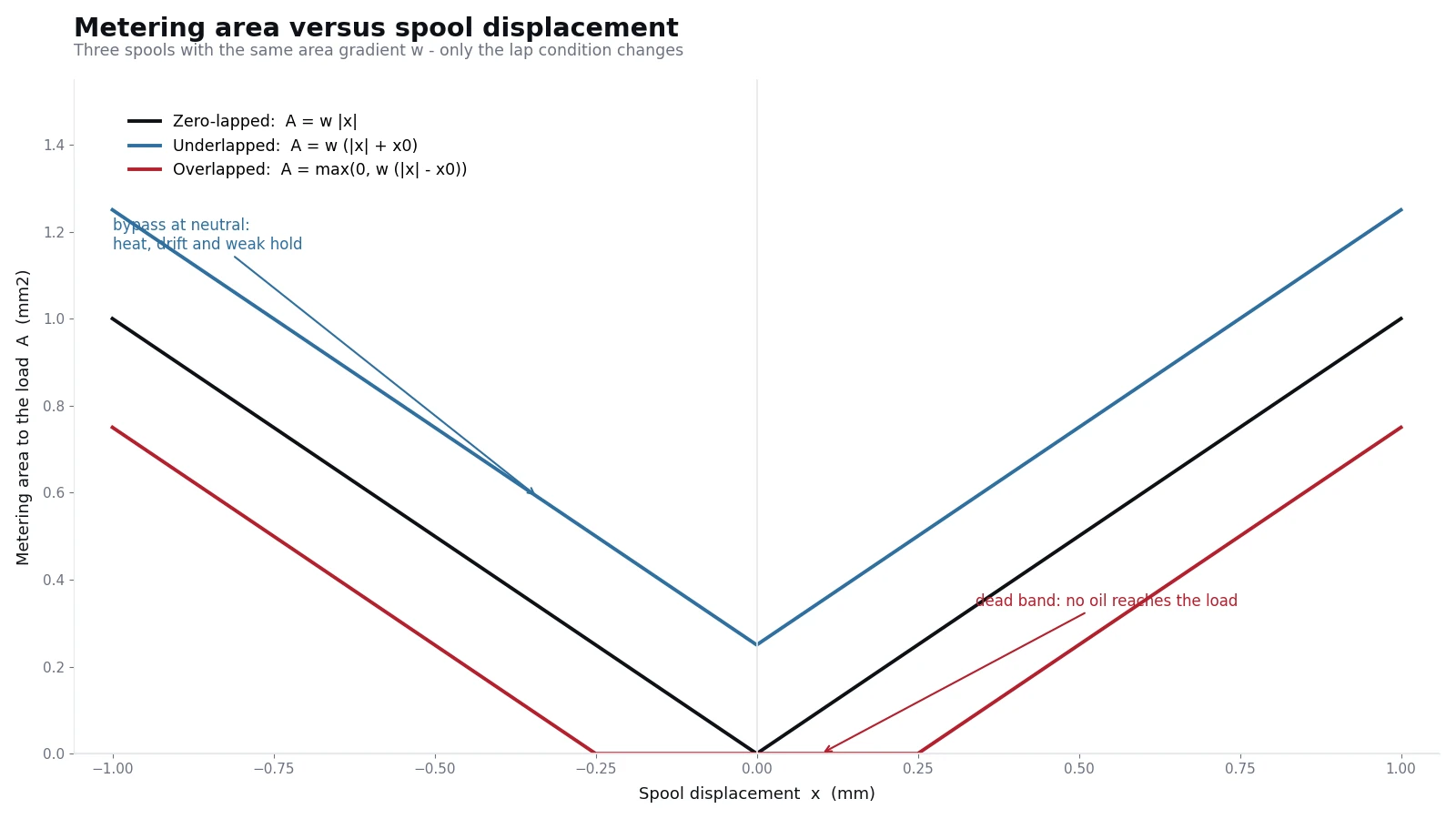
Plot the opening area against spool displacement and the shape of the curve explains the machine:
- Slope (flow gain) - a steep curve gives a fast, sensitive response; a shallow one feels sluggish and needs more lever travel.
- Value at neutral - leakage past a slightly open or worn edge shows up as drift, heat and a machine that will not hold a raised load.
- Dead band - the flat region of an overlapped spool is not a fault; it is designed in, and it is why some functions always feel different from others.
Flow force: why spools are shaped and not just sized
Oil crossing the metering gap changes direction, and the momentum change pushes back on the spool. The reaction always acts to close the opening, and it grows with flow and with the pressure drop across the edge. This is the reason large flows are not controlled by large spools alone: a small pilot stage moves the main spool, and the main stage is shaped, chamfered and sometimes grooved so that the force stays manageable and predictable.
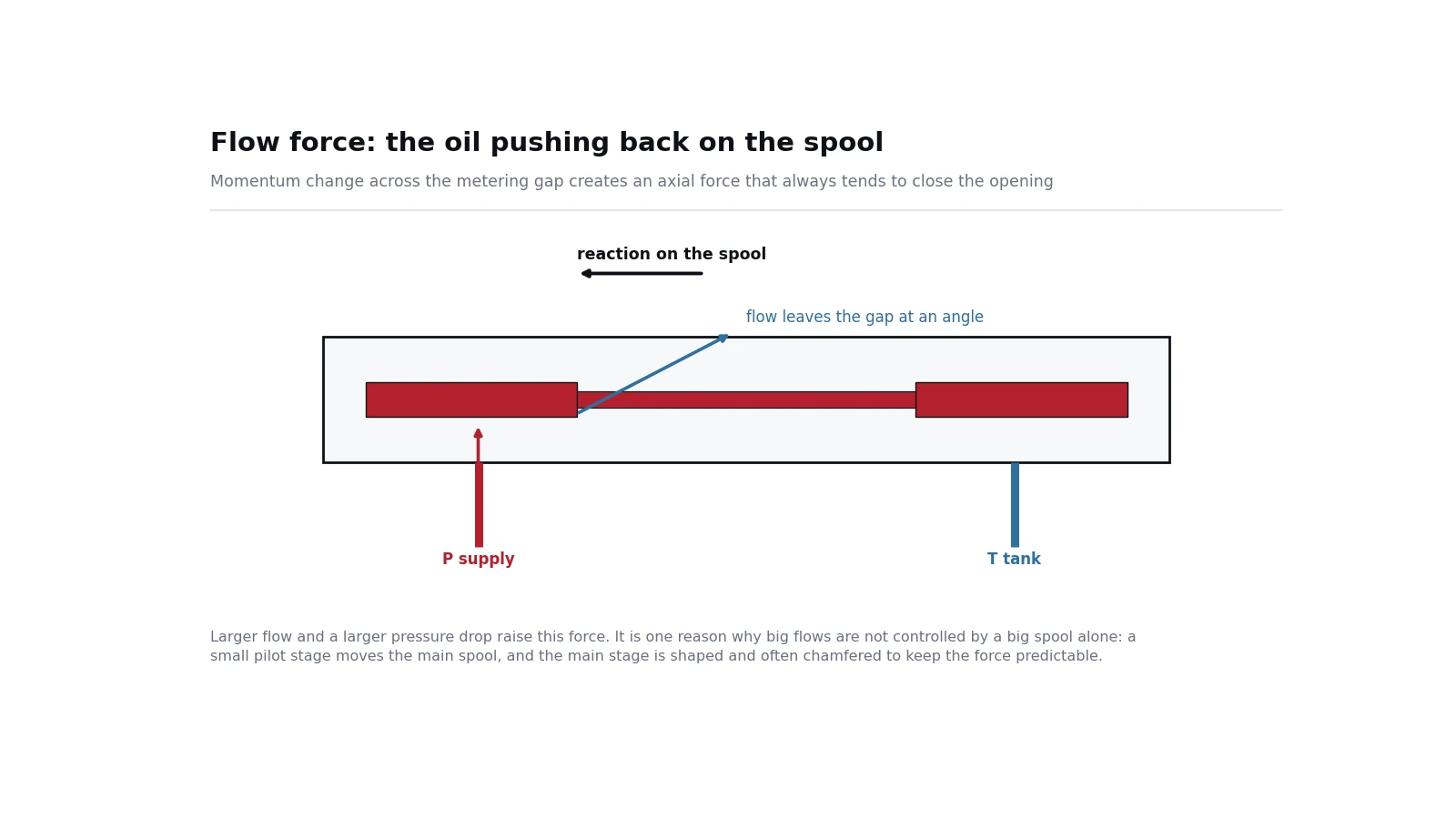
In practice this is why a worn spool can feel unstable rather than simply weak, and why a regulator that has been repaired with mismatched parts may hunt or stick instead of holding a steady displacement.
What we check before quoting a regulator or a control section
- The control suffix, not the machine model. K3V112DTP and K3V112DTH share displacement but not the regulator. The suffix on the nameplate is what identifies the spool inside.
- Shaft, flange and rotation. These decide whether a unit bolts on; the lap condition decides whether it behaves like the old one.
- The symptom in the machine. Sluggish in one direction, drifting under load or sticking when cold - each points at a different part of the spool and seat assembly.
- Oil condition. Particles the size of the spool clearance land in the clearance. A repaired valve in a dirty circuit repeats the failure.
Related field checks
If you are diagnosing rather than ordering, start from the symptom: spools sticking when cold, drift under load, all functions slow, or the engine bogging down under load. Each guide lists the checks in the order a workshop should work through them.
Diagrams in this article are drawn by our own team. Technical principles referenced from the public course “Hydraulic Servo and Proportional Control Systems” (Yanshan University).