
What actually holds a spool
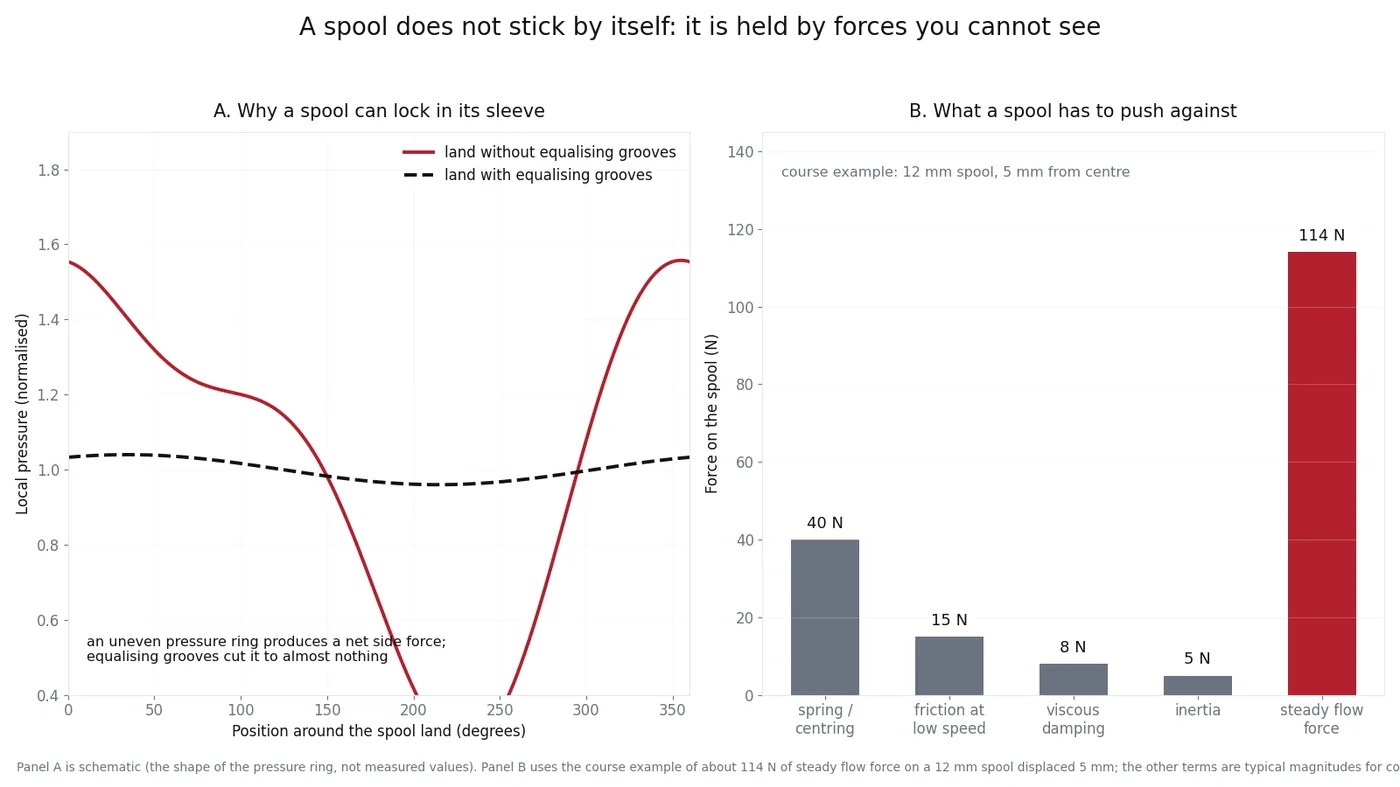
A spool is a small piston in a very tight sleeve. Take its force balance apart and you find terms that have nothing to do with wear: inertia, viscous damping, spring or centring force, friction at low speed, the external load from the lever or the pilot, and the hydraulic flow force. The flow force alone is not a rounding error - in the textbook example used in our training material, a spool of about 12 mm diameter displaced 5 mm carries roughly 114 N of steady flow force, which is why high flows are never driven directly by the main spool but through a pilot stage.
The three ways a spool gets stuck
- Hydraulic lock (side force). If the pressure distribution around a land is not symmetric - a slight taper from grinding, an off-centre bore, a scored land - the imbalance pushes the spool against the sleeve with a force that grows as the pressure rises. This is why a machine whose lever is stiff only when the oil is hot is telling you about geometry and pressure, not about grease.
- Contamination and varnish. Clearances are measured in single micrometres. A particle that lodges changes the force balance; varnish from degraded oil does the same thing slowly and temperature-dependently.
- Thermal and mechanical distortion. A valve body bolted to a warm casting, or a machine working at high pressure for hours, moves metal. Some valves that stick "only after two hours of work" are not dirty at all - they are distorted.
Why some designs stick less than others
Two design choices matter, and both are visible from the outside if you know what you are looking at:
- Equalising grooves and auxiliary shoulders. Grooves machined around the spool lands break the pressure ring into small pockets and cut the side force to almost nothing. It is a cheap feature that decides whether a valve feels smooth or gritty at ten years old.
- The centre condition. An underlapped spool - one that is slightly open at neutral - has a small dead band, good linearity and, importantly, tolerance of contamination: a particle sitting in a slightly open edge is less decisive than a particle wedged in a closed clearance. A zero-lapped spool gives the best performance and the least tolerance; that is the trade, and it is why some machines are simply fussier about oil than others.
What to do before you open the valve
- Characterise the stick. Cold or hot? One function or several? One direction only? Does it free up when the machine warms? These four answers separate contamination, distortion and side force.
- Change the filter, check the oil history, flush. Most intermittent sticking that we are asked about disappears at this step - and it costs a fraction of a valve.
- Measure the command side. On a proportional or servo system, measure coil current and pilot pressure: a "stiff lever" can be a weak pilot, not a stuck spool.
- Then open it, photograph it, and keep the photographs. Scoring marks, varnish, and the wear pattern on the lands tell the next person what happened.
Send the photographs and the machine model. If the verdict is a new spool or a new valve section, the part number - not the casting number - is what identifies the right one, and we would rather quote the right part than sell you a valve body.
Related reading: one valve body, many spools, spool sticking at cold start, and cleanliness targets.