
One number explains most repair bills
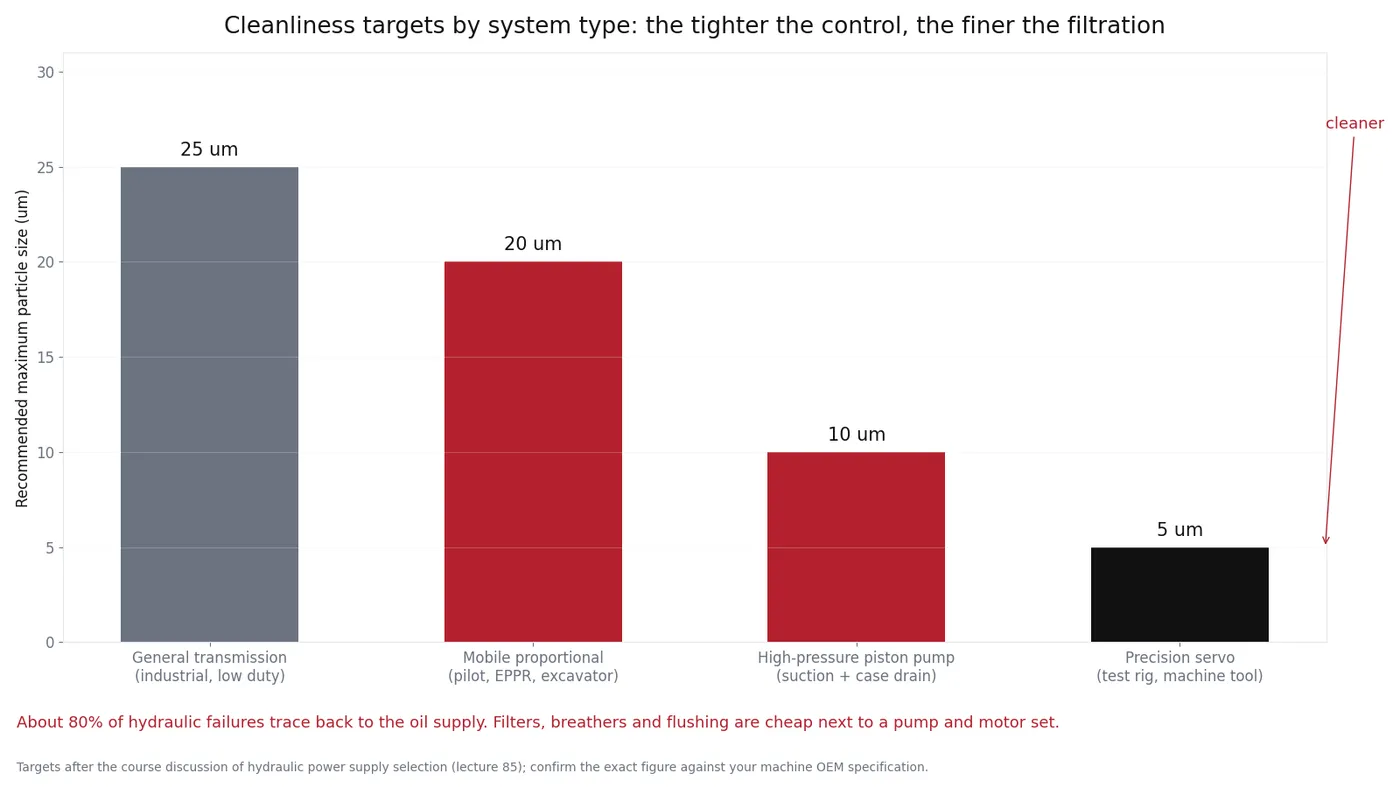
When hydraulic failures are traced back, the source is usually the oil supply rather than the component that finally broke. The engineering literature used in our training material puts the share at roughly 80%, and the same source gives the reason: the cleaner the system, the tighter the clearances, and the tighter the clearance, the smaller the particle that will jam it.
The targets scale with the precision of the control:
- General transmission - particles of a few tens of micrometres are tolerable. Smooth, low-duty circuits forgive a lot.
- Mobile proportional control - the working figure is around 20 µm. That covers pilot-operated excavator circuits, proportional solenoids and the pilot stage of a pump regulator.
- Precision servo - single-digit micrometres. Anything coarser will not keep a servo valve repeatable.
Why the pilot stage dies first
The main spool of a control valve has clearance measured in tens of micrometres and tolerates some dirt. The pilot stage does not. A nozzle-flapper or jet-pipe stage works with gaps of a few micrometres, and a single particle lodged there changes the pressure balance that positions the main spool.
Valve designers know this, which is why some two-stage valves fit a filter immediately upstream of the fixed orifice that feeds the nozzle. That filter exists purely to keep the nozzle and flapper clear. On an excavator the same logic applies to the regulator on a K3V or K5V pump: a contaminated pilot supply turns into slow response, hunting, or a function that works one minute and not the next.
"Works sometimes" is the signature. A hard failure is easy to find; an intermittent one is usually a particle sitting in a gap and moving.
Where the contamination comes from
| Source | How it enters | What to do |
|---|---|---|
| New oil | Delivered oil is not clean oil - a drum is often dirtier than the tank | Filter on transfer; never top up through a dirty funnel |
| Tank breather | A damaged breather admits dust continuously, all shift long | Replace on schedule; clean the tank neck before opening |
| Cylinder rod seals | Worn wiper seals push mud back into the circuit | Inspect wipers; rebuild leaking cylinders instead of topping up oil |
| Hose and pipe work | Cuttings and rubber from a hose made on site circulate for years | Flush new hose before fitting; cap open ports |
| Repair bench | Assembly in a dusty workshop puts grit inside the unit | Clean bench, lint-free cloths, no open units overnight |
| A previous failure | Debris settles in cylinders, coolers and lines | Flush the whole circuit before the replacement pump is started |
What actually pays for itself
- Filter by particle count, not by hours. Two machines with the same interval can differ by a factor of ten in ingressed dirt.
- Check the bypass. A filter that opens its bypass dumps everything it has collected straight downstream. A cheap filter with the wrong bypass setting is worse than an expensive filter.
- Sample the oil. Particle count, water and viscosity in one report tell you whether the oil is protecting the unit or attacking it.
- Flush after every failure. This is the difference between one repair and three.
- Keep water out. Water emulsifies oil and corrodes the valve plate and bearings; it hurts even when the particle count looks acceptable.
If you are replacing a pump or a motor, the parts that protect the investment are unglamorous: the filter, the breather, the seal kit, and a case drain line that is checked hot. We keep all of them, and we would rather sell you those than sell you a second pump.
Related reading: oil contamination in the field, the references we use for cleanliness data, and the parts library.