
Why a pump needs a pilot stage at all
The regulator on a K3V or K5V pump has to move a swash plate against real forces: the piston and slipper pair push back, the control spring resists, and the oil crossing every metering edge pushes the spool towards closing. A signal coming from a joystick, a solenoid or a torque-motor armature is far too weak to overcome that directly.
The answer used in almost every modern pump and proportional valve is a pilot stage: a very small hydraulic device moves a very small spool, and that spool controls pressure to a bigger spool, which finally strokes the pump. Two designs dominate - the nozzle-flapper valve and the jet-pipe valve. Both convert a movement of micrometres into a pressure difference that drives the main spool.
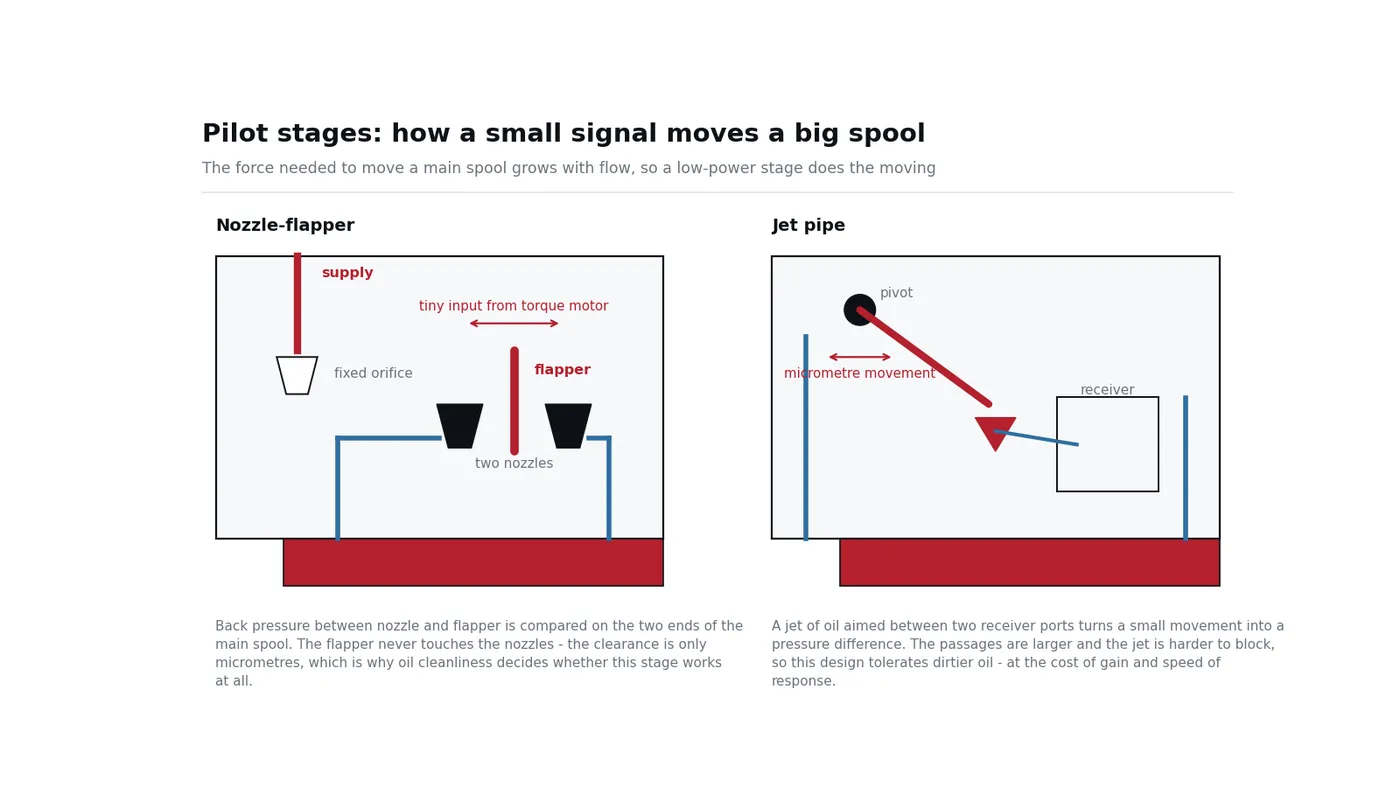
Nozzle-flapper: highest gain, tightest tolerances
Oil passes a fixed orifice and then escapes through two nozzles, one on each side of a flapper. Moving the flapper closer to one nozzle raises the back pressure upstream of it and lowers it on the other side. That pressure difference is applied to the two ends of the main spool, which moves until the feedback spring stops it.
- Strength: very high gain from a tiny input, fast response, small package - which is why it is used where control accuracy matters.
- Weakness: the nozzle clearance is of the order of micrometres. Particles of the wrong size, varnish from overheated oil or a swollen seal are enough to block a nozzle.
- Typical failure: one nozzle plugs, the pressure difference sticks, and the pump either refuses to stroke or hunts instead of holding a steady displacement.
Jet pipe: less gain, far more forgiving
A jet pipe aims a stream of oil between two receiver ports. Moving the pipe slightly makes the jet favour one port, creating the pressure difference that moves the main spool. There is no nozzle-flapper clearance to block, and the passages are larger.
- Strength: tolerates dirtier oil and rougher operating conditions, and degrades gradually rather than suddenly.
- Weakness: lower gain and slightly slower response than a clean nozzle-flapper stage, and it needs a steady supply pressure to keep the jet coherent.
| Pilot stage | Gain / response | Cleanliness needed | How it usually fails |
|---|---|---|---|
| Nozzle-flapper | Highest, fastest | High - fine filtration is not optional | Nozzle partially blocked: hunting, no stroke, unstable pressure |
| Jet pipe | Moderate | Moderate | Wear and misalignment: slow, weak response that gets worse with heat |
| Direct-operated spool | Lowest per unit size | Moderate | Spool sticking, scoring, spring fatigue |
What this means in the workshop
- Filtration is part of the repair, not an accessory. A pilot stage repaired in a dirty circuit fails again, and the operator usually reports it as "the same fault as before".
- Do not open a pilot stage on a bench in a dusty workshop. Clean the machine down, cap every port, work on a clean surface and use lint-free wipes.
- Never mix parts between variants. Two units of the same displacement can carry different pilot stages and different control codes; the nameplate suffix is what identifies them.
- A symptom that appears only when the oil is hot points at clearances and internal leakage rather than at the electrical signal.
- A pump that will not build pressure at all, with correct relief setting and a healthy-looking rotary group, deserves a look at the pilot stage before the unit is condemned.
Field guides that walk through these symptoms: pump builds no pressure, spools sticking when cold, oil contamination and the case drain flow test.
Diagram drawn by our own team and deliberately simplified; it shows principles rather than any one manufacturer's internal layout. Technical principles referenced from the public course “Hydraulic Servo and Proportional Control Systems” (Yanshan University).