Excavator Hydraulic System Maintenance and Care Guide: From Daily Inspection to Fault Diagnosis
An excavator is a typical electromechanical-hydraulic integrated construction machine. The engine provides power, while the hydraulic system converts the engine’s mechanical energy into hydraulic energy. Through components such as the hydraulic pump, main control valve, hydraulic motors, and hydraulic cylinders, this power is accurately transmitted to the boom, arm, bucket, swing mechanism, and travel system.
Therefore, any problem in the hydraulic system usually directly affects the excavator’s working speed, digging force, travel ability, swing performance, and overall reliability.
Many hydraulic system failures do not occur suddenly. They result from long-term neglect of hydraulic oil contamination, clogged filters, excessive oil temperature, air ingress into the lines, improper operation, and similar issues that accumulate over time before becoming apparent.
For example, an excavator may initially show only “slightly slower movements.” The owner continues working without addressing it. Months later, symptoms escalate to “insufficient pressure, weak actions, and increased hydraulic pump noise.” When the pump is finally disassembled, severe wear is found on the pistons, cylinder block, and valve plate.
Thus, the true core of hydraulic system maintenance is not “how to repair it after it breaks,” but rather “how to maintain it correctly so that the hydraulic system fails as little as possible.”
1. Understanding the Excavator Hydraulic System: Why It Matters So Much
A typical excavator hydraulic system consists of the following main parts:
- The hydraulic pump generates hydraulic energy.
- The main control valve distributes and controls the hydraulic oil.
- Hydraulic cylinders drive the boom, arm, and bucket.
- The swing motor drives upper-structure rotation.
- Travel motors drive the tracks.
- The hydraulic oil tank stores, cools, and settles the oil.
- Filters remove contaminants.
- Lines and fittings convey the hydraulic oil.
In simple terms: The engine is the “heart,” the hydraulic pump is the “power source,” hydraulic oil is the “blood,” the lines are the “blood vessels,” the main control valve is the “brain,” and the cylinders and motors are the “muscles.”
A serious problem in any of these links can affect the entire machine.
2. The Most Important First Priority in Hydraulic Maintenance: Keep the Hydraulic Oil Clean
In actual repair work, one of the most common and most easily overlooked problems is hydraulic oil contamination.
Contaminants in the hydraulic system mainly include:
- Dust
- Sand particles
- Metal wear debris
- Seal fragments
- Moisture
- Deposits from oil oxidation
- Foreign matter introduced during maintenance
For ordinary machinery, a little dust may have limited effect. For high-precision hydraulic pumps and valves, the situation is completely different.
A piston pump contains many precision mating surfaces. The clearances between pistons, cylinder block, valve plate, and slippers are critical. If hard particles remain in the oil for a long time, these precision parts undergo continuous abrasive wear.
This can ultimately lead to: increased internal leakage → reduced volumetric efficiency → lower flow → difficulty building pressure → slower movements → system overheating.
3. Case 1: Hydraulic Oil Contamination Causes Premature Pump Failure
A typical excavator fault: The machine works normally at first, but after one or two hours of operation, movements gradually become slower.
The owner’s first reaction: “The hydraulic pump is getting old.”
Technicians performed pressure tests. In the cold state:
- System pressure was basically normal.
- Operating speed was also basically normal.
After working for a period:
- Oil temperature rose.
- Operating speed dropped.
- Digging force decreased.
- Pressure build-up became slower.
Disassembly of the pump revealed clear wear on the mating surfaces of the valve plate and cylinder block. Further inspection of the oil showed severe contamination.
This illustrates a very typical problem: The pump did not “suddenly fail.” Long-term oil contamination caused progressive internal wear.
Therefore, when repairing a hydraulic pump, one must not only consider “replacing it with a new pump.” One must also ask: Why did the old pump fail?
If the contamination source is not eliminated, the new pump will continue to be exposed to contaminated oil. The result is: new pump → contaminated oil → renewed wear → repeated failure.
This is a fundamental principle of hydraulic system repair: Find the root cause before repairing the pump; control contamination even more carefully after replacing the pump.
4. When Changing Hydraulic Oil, Do Not Focus Only on “Whether the Oil Was Changed”
Many owners believe: “The hydraulic oil has been replaced with new oil, so the system must be fine.”
This is not necessarily true.
When changing hydraulic oil, attention must also be paid to:
- Is the inside of the tank clean? If large amounts of sediment remain at the bottom of the tank, contaminants can re-enter the system after new oil is added.
- Were the filters inspected or replaced at the same time? An old filter may already be near saturation. Continued use reduces filtration effectiveness and, in severe cases, can cause bypass.
- Is the oil-filling equipment clean? Using a container that previously held diesel, engine oil, or other fluids can easily introduce contaminants into the hydraulic system.
- Does the oil grade meet the requirements? Different machines may require different viscosity grades and performance specifications. One cannot simply assume “it’s all hydraulic oil, so any type will do.”
5. Case 2: Why Did the New Hydraulic Pump Fail Again After Only a Few Hundred Hours?
A common and frustrating situation on the repair site: “We just installed a new pump. Why did problems appear again after only a few hundred hours?”
Inspection showed the new pump itself had no obvious manufacturing defects. The real problem was that system contamination had not been resolved.
For example, the original pump had suffered severe mechanical damage and generated large amounts of metal particles. Technicians only performed: remove old pump → install new pump → add oil → start the machine.
They did not adequately clean:
- The hydraulic oil tank
- The lines
- The filters
- The main control valve
- The return system
Residual metal particles continued to enter the new pump. The new pump then developed:
- Noise
- Pressure drop
- Flow reduction
- Temperature rise
This is a classic case of: “The pump failed, but the true fault source remained inside the system.”
Hydraulic system repair cannot focus only on a single component. It must be treated as a system-level repair.
6. Excessively High Hydraulic Oil Temperature Is Also a Danger Signal
A certain amount of heat is generated during normal hydraulic system operation. However, if oil temperature remains abnormally high for a long time, the system likely has a problem.
Common causes include:
- Internal leakage in the hydraulic pump
- Internal leakage in the main control valve
- Continuous relief at the relief valve
- Clogged radiator
- Blocked air passages
- Inappropriate oil viscosity
- Abnormal system pressure settings
- Wear of hydraulic components
Simply put: When the heat generated by the hydraulic system exceeds the heat that the cooling system can dissipate, oil temperature continues to rise.
7. Case 3: The Excavator Loses Power the Longer It Works — The Problem May Not Be the Engine
An excavator showed the following symptoms: It worked normally in the morning. After several hours of operation, movements became progressively slower.
The owner thought: “Is the engine losing power?”
Technicians checked the engine and found it was essentially normal. They then inspected the hydraulic system: Cold condition:
- Movements normal
- Pressure normal
Hot condition:
- Movements clearly slower
- System pressure dropped
- Oil temperature markedly elevated
Further inspection of the pump revealed internal wear causing increased internal leakage.
This created a vicious cycle: Pump wear → increased internal leakage → reduced hydraulic efficiency → increased heat generation → higher oil temperature → further increase in pump internal leakage → progressively slower movements
Therefore, “slow when hot, normal when cold” is a phenomenon that deserves special attention in hydraulic fault diagnosis.
8. The Third Key Point of the Hydraulic System: Prevent Air from Entering the System
Many people only pay attention to whether hydraulic oil is leaking outward and overlook that the hydraulic system can also “suck air,” especially on the pump suction side.
If the suction line, seals, or fittings have problems, little or no external oil leakage may be visible, yet air can enter the system.
Air ingress can cause:
- Increased hydraulic pump noise
- Bubbles in the oil
- Jerky actuator movements
- Unstable operating speed
- Cavitation in the pump
9. Case 4: The Hydraulic Pump “Hums” Loudly — Does That Necessarily Mean the Pump Is Damaged?
An excavator developed noticeably louder pump noise during operation. The owner immediately concluded: “The hydraulic pump is bad.”
Technicians did not immediately disassemble the pump. They first checked:
Step 1: Oil level — normal. Step 2: Oil condition — basically normal. Step 3: Suction line — poor sealing at a suction fitting was found.
After replacing the seal and retesting, pump noise decreased significantly.
This shows that abnormal pump noise does not necessarily mean internal pump damage.
A key principle in hydraulic diagnosis is: First eliminate simple, common, low-cost problems before considering disassembly of expensive components.
10. Hydraulic Filters: A Small Part That Can Affect the Entire System
Hydraulic filters play a critical role in removing contaminants. A clogged filter can cause:
- Insufficient flow
- Abnormal pressure
- Difficulty in pump suction
- System overheating
- Component wear
However, one should not assume “the finer the filter, the better.”
Actual selection must consider:
- Filtration rating
- Flow capacity
- Pressure drop
- Filter media
- Structural strength
- Manufacturer requirements
Especially on the pump suction side, excessive filtration resistance can cause suction difficulty.
11. Case 5: Why Did Abnormalities Appear After the Filter Was Replaced?
After a hydraulic filter was replaced on an excavator, the pump noise increased and movements became unstable.
Technicians found that although the filter “could be installed dimensionally,” its specifications did not fully match.
This reminds us: A hydraulic filter cannot be judged only by whether it fits. One must also confirm:
- Part number
- Filtration rating
- Flow capacity
- Pressure drop
- Seal dimensions
- Compatible fluid
- Manufacturer technical requirements
For hydraulic systems, “it fits” does not equal “it is correct.”
12. Main Control Valve Problems Should Not Be Misdiagnosed as Pump Failure
This is a very common misjudgment during repairs.
Example: The boom moves slowly. Many people’s first reaction: “The pump is no good.”
In reality it may be:
- A problem with the main control valve spool
- Spool sticking
- Abnormal pilot pressure for that circuit
- A line problem
- Internal leakage in the cylinder
Therefore, when diagnosing:
- If all movements are slow, focus on: engine → hydraulic pump → main supply system.
- If only one movement is slow, focus on: corresponding control valve → lines → actuator.
13. Case 6: Only the Bucket Moves Slowly, Yet the Pump Was Replaced
An excavator showed: Bucket movement was clearly slower than before.
Technicians did not perform a complete diagnosis and concluded: “Pump pressure is insufficient.”
They replaced the hydraulic pump. Result: the bucket was still slow.
Further inspection revealed an abnormality in the corresponding control valve that restricted flow to the bucket cylinder.
This is a typical case of incomplete fault diagnosis leading to unnecessary parts replacement.
Therefore, hydraulic system repair must follow a basic principle: “The symptom” is not the same as “the cause.”
For example, “slow movement” is only a symptom. The true cause may lie in the pump, valve, oil, lines, actuator, or control system.
14. Hydraulic Lines and Fittings Must Also Be Inspected Regularly
During long-term operation, excavators are subjected to:
- Vibration
- Shock
- High temperature
- Dust
- Mud and water
- Stone impacts
Consequently, hydraulic hoses may develop:
- Aging
- Cracks
- Bulging
- Abrasion
- Loose fittings
- Seal failure
This is especially critical for high-pressure hoses. If severe abrasion or bulging is found, one should not adopt the attitude of “it can still be used a little longer.”
Sudden rupture of a high-pressure hose can not only stop the machine but also create serious personal safety risks.
15. Hydraulic Cylinder Maintenance: Do Not Neglect the Piston Rod
Boom, arm, and bucket cylinders are exposed to harsh environments for long periods.
If the piston rod surface is:
- Scratched
- Rusted
- Bent
- Covered with mud and sand
it will affect seal life.
In particular, continuing to operate with obvious scratches on the piston rod can lead to: piston rod → scratches the seal → oil leakage → further seal damage.
Therefore, when repairing, one must not only replace the seals but also determine why the seals failed. If the piston rod is already severely damaged, simply replacing the seals usually cannot solve the problem at its root.
16. How Should Daily Maintenance of the Excavator Hydraulic System Be Performed?
A simple maintenance routine can be established.
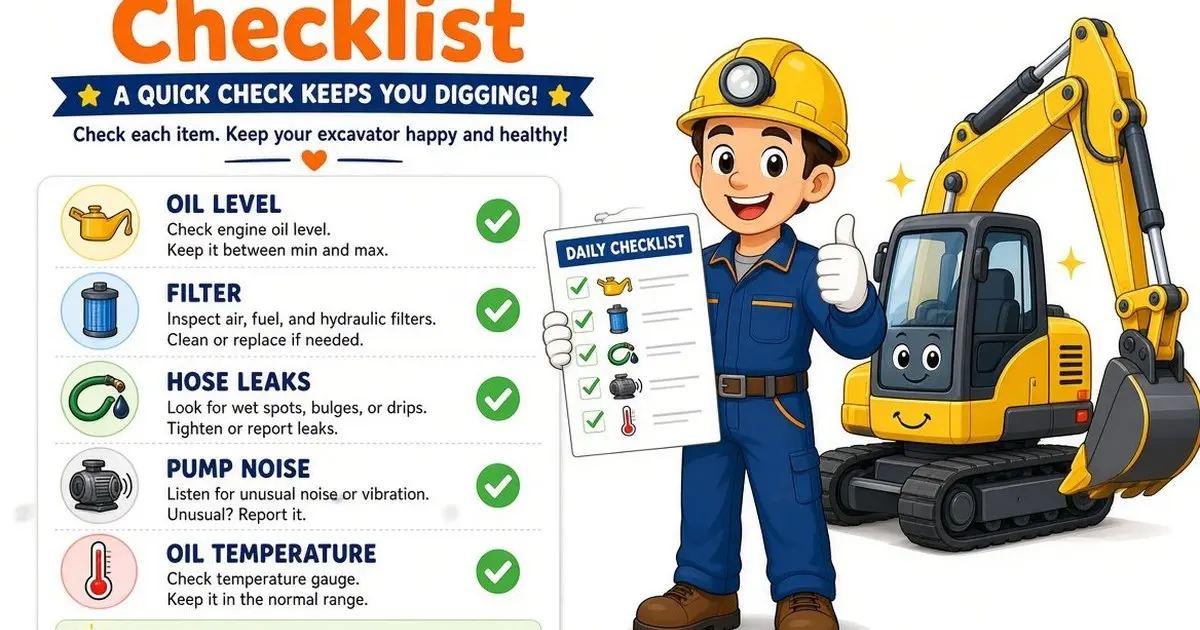
Before starting each day, check:
- Hydraulic oil level
- Whether the oil shows obvious abnormalities
- Whether hoses are leaking
- Whether fittings are loose
- Whether cylinders are leaking
- Whether the pump has abnormal noise
- Whether the hydraulic system has abnormal vibration
During operation, pay attention to:
- Whether movements become slower
- Whether digging force decreases
- Whether swing is abnormal
- Whether travel is abnormal
- Whether oil temperature is abnormal
- Whether pump sound changes
Do not wait until “the machine can no longer move at all” before beginning inspections.
Periodic maintenance In accordance with the manufacturer’s requirements, inspect or replace:
- Hydraulic oil
- Return filter
- Suction filter
- Pilot filter
- Breather
- Hydraulic lines
- Hydraulic oil tank
Under severe working conditions, maintenance intervals should be shortened according to actual conditions.
17. Truly Professional Hydraulic Maintenance: Upgrading from “Scheduled Oil Changes” to “Condition Monitoring”
The traditional maintenance approach is: “After a certain number of operating hours → change the oil.”
Modern hydraulic system maintenance increasingly emphasizes maintenance based on the actual condition of the equipment.
This can be achieved through:
- Pressure testing — to determine whether system pressure is normal.
- Flow testing — to determine the actual output capability of the pump.
- Temperature monitoring — to determine whether abnormal energy losses exist.
- Noise monitoring — to detect abnormalities in pumps or motors.
- Oil cleanliness testing — to assess the cleanliness of the hydraulic oil.
- Wear-particle analysis — to judge whether abnormal internal wear is occurring by examining metal particles in the oil.
In this way, maintenance can gradually shift from “repair after failure” to “detect abnormal trends → perform maintenance in advance.”
This is the core idea of preventive and predictive maintenance.
18. The “Five Taboos” of Excavator Hydraulic System Maintenance
Finally, several very important principles from actual repair work:
Taboo 1: Continuing to use dirty hydraulic oil. Contamination continuously wears precision hydraulic components.
Taboo 2: Only topping up oil when leakage is found, without finding the cause. Topping up only addresses the oil quantity; it does not solve the leakage problem.
Taboo 3: Immediately replacing the pump as soon as a pump problem appears. One must first determine why the pump failed.
Taboo 4: Failing to clean the system after installing a new pump. Metal particles generated by the old pump’s failure may continue to damage the new pump.
Taboo 5: Randomly mixing hydraulic oils of different specifications. Oil should be selected according to the manufacturer’s requirements and the technical specifications of the fluid.
19. Conclusion: What Is the Essence of Hydraulic System Maintenance?
Excavator hydraulic system maintenance appears to consist of changing oil, changing filters, and checking for leaks.
But truly professional maintenance actually does three things:
First, control contamination — keep the hydraulic oil sufficiently clean. Second, control temperature — prevent the hydraulic system from operating for long periods at abnormally high temperatures. Third, detect abnormalities in time — use pressure, flow, temperature, noise, oil condition, and working performance to judge whether the hydraulic system is changing.
Ultimately, a complete maintenance logic is formed: correct operation → regular inspection → preventive maintenance → fault diagnosis → root-cause analysis → correct repair → system cleaning → post-repair verification.
For the hydraulic pump in particular, one sentence should be remembered: When a hydraulic pump fails, replacing the pump only addresses the “result.” Finding out why the pump failed is what addresses the “cause.”
This is also an important criterion for judging whether a hydraulic repair technician is truly professional.