
A century of one number going up
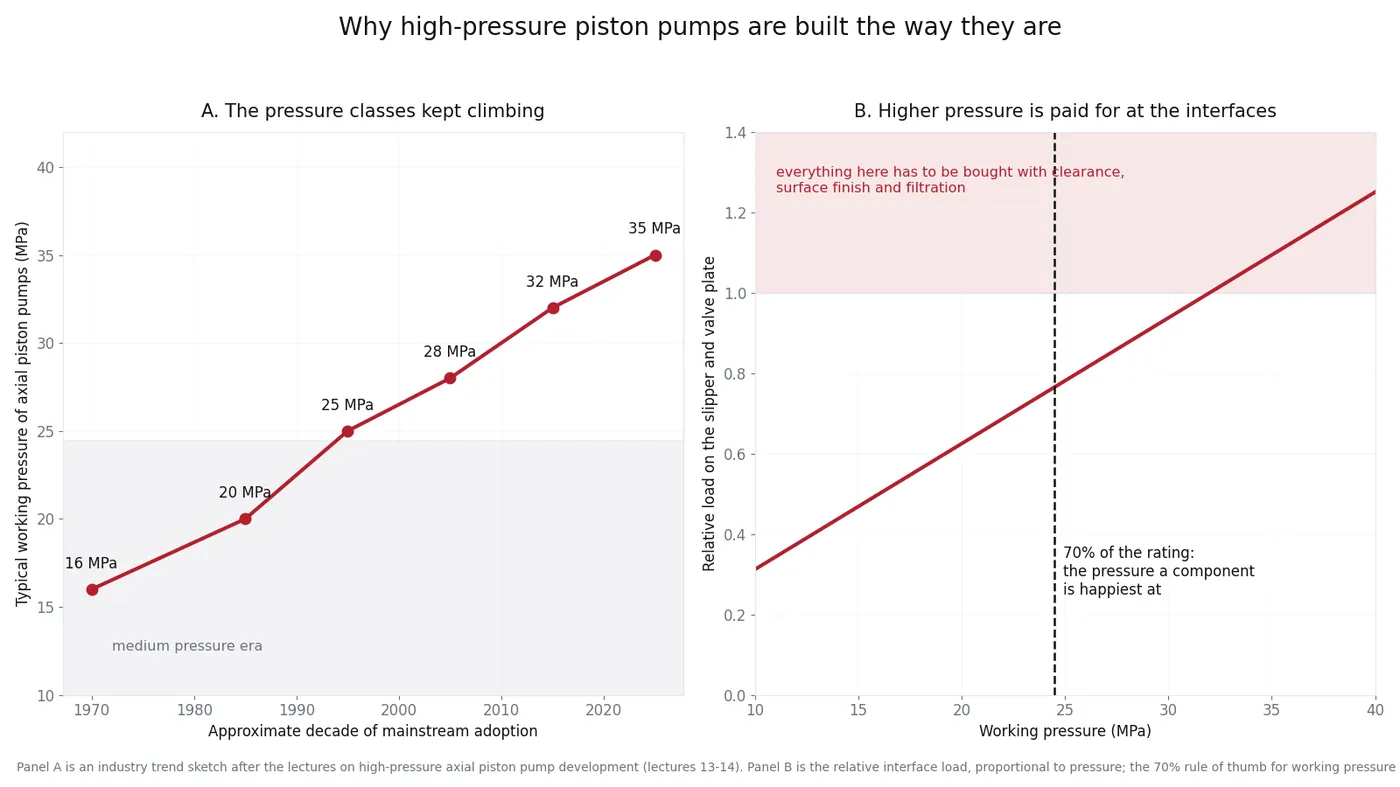
Axial piston pumps have been the high-pressure workhorse of hydraulics for a century, and the industry's progress can be read off a single curve: the working pressure a mass-produced pump can hold, year after year. Each step - from around 16 MPa to 20, 25, 28, 32 and now 35 MPa and beyond in some series - required the whole supply chain to move with it.
The course material on high-pressure pump development makes the underlying point bluntly: the level of the components constrains the equipment. A machine's capability is not set by the idea behind it, but by what the pumps, valves and seals can survive in the field.
Where the pressure is actually spent
Inside a piston pump, two interfaces carry the consequences: the slipper and swashplate, and the valve plate with the cylinder block. Both work with a film of oil measured in micrometres, and the load on that film rises with pressure while the film has to stay thick enough to avoid metal contact. Higher pressure therefore buys its rating with:
- tighter and more consistent clearances (which means better machining and better filtration),
- better materials and surface treatment on the sliding pairs,
- careful timing of the valve plate ports, so that the pressure transition does not hammer the edges,
- and - in service - oil that is clean and cool enough to keep the film intact.
Which is why a pump that is rated to 35 MPa is not automatically a better pump at 20 MPa. It is a pump whose design was pushed further, and it depends more on the oil.
The 70% rule, and what it means on a machine
The reliability guidance that comes out of the same lectures is compact and practical: work at about 70% of the component's maximum pressure rating. The reserve is what absorbs the transients, the cold starts, the contamination events and the ten-year life that the machine specification actually implies.
Translating it into three field decisions:
| Decision | What the 70% rule says |
|---|---|
| Main relief setting | Set to the machine specification, not higher - a relief is a safety device, not a performance setting |
| Choosing a replacement unit | Match the pressure class and the control variant on the nameplate; a higher-rated unit is not an upgrade if the control or flange is different |
| Working practice | Sustained work at the top of the rating shortens life; the reserve is there for peaks, not for the shift average |
What the industry is betting on now
The keywords around modern high-pressure hydraulics are consistent across manufacturers: high performance, high reliability, green and efficient, electro-mechanical-hydraulic integration, and modular system design. Two of those have direct consequences for machine owners:
- The displacement control mechanism is the energy lever. A variable pump that reduces displacement when full power is not needed is the difference between fuel burned and fuel saved - which is why regulators, and the spools inside them, are worth as much attention as the rotating group.
- Maintenance philosophy changed. Repairing after failure is being replaced by proactive maintenance: oil changed on a schedule rather than when it smells, filters and breathers treated as consumables, and case drain flow trended like a wear gauge. All of it costs a fraction of one pump.
Our own specification sheet lists the K3V / K5V / M5X / FTD range with displacement, pressure, speed and torque taken from the makers' catalogue, and every unit we ship is identified by the nameplate rather than by the machine it fits. That is the same discipline as the 70% rule: the number on the plate decides, not the marketing.
Related reading: cleanliness targets by system type, flow gain and load matching, and the specification sheet.