
A two-to-one price gap, and why buyers still pay it
One of the more candid observations in our training material is commercial rather than technical: imported hydraulic components cost roughly twice what locally produced equivalents cost, and equipment makers keep buying the imported ones. That is not brand loyalty. It is a reliability judgement made by people who have to warranty the machine.
The reason is specific and it has been the same for decades. Switching valves were solved long ago. The layer above them - proportional valves and, above all, proportional solenoids - is where the difficulty sits, and it is a difficulty of materials, precision manufacturing and supporting industry rather than of design drawings.
The stack, and where the difficulty lives
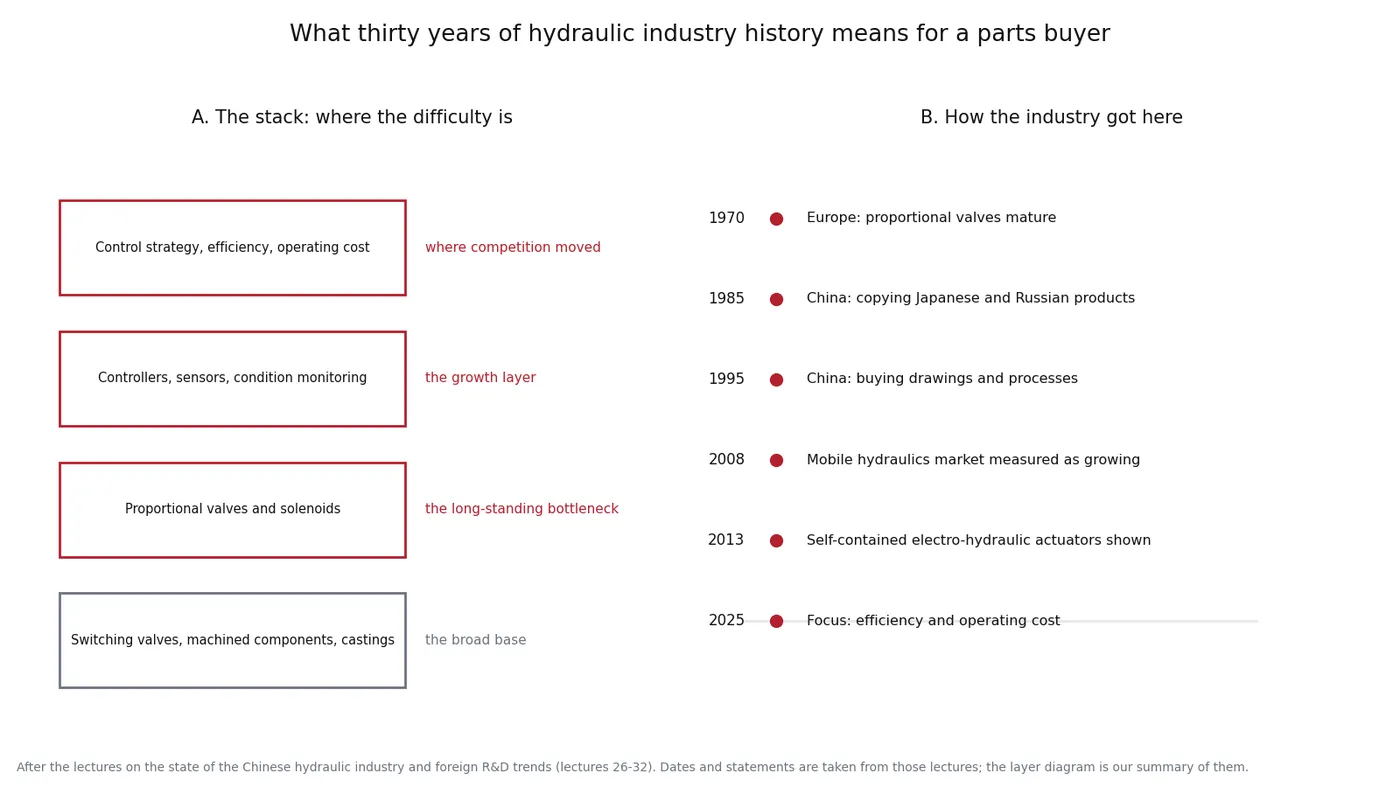
The history behind that stack is worth knowing because it explains what you are buying:
- 1970s: switching and proportional valves reach maturity in Europe, and research attention moves upward to condition monitoring, computer control and overall system efficiency.
- 1980s: Chinese manufacturers copy Japanese and Russian products with production equipment that cannot hold the tolerances those products require.
- 1990s: drawings and processes are purchased, but materials, tooling and management systems lag behind.
- 2000s onward: the mobile hydraulics market - construction, mining, agriculture, environmental - grows into the dominant segment, and the competitive question shifts from build cost to operating cost: efficiency and control strategy.
- 2010s: self-contained electro-hydraulic actuators appear - motor, pump, tank, valve and drive integrated into one unit that takes commands directly, which is where some travel and auxiliary functions are heading.
What this means at the parts counter
| Situation | What is usually true | What to do |
|---|---|---|
| Rotating group, castings, shafts, seal kits | Well established locally, quality depends on the specific maker, not the country | Buy by part number and maker; ask what standard the tolerances are held to |
| Proportional solenoids, EPPR valves, controllers | The historical weak point; failures are often electrical or magnetic rather than hydraulic | Expect a price difference and ask for the OEM part number rather than a "fits" claim |
| Complete units offered at a suspiciously low price | Usually a rebuilt core with an unknown rotating group | Ask what was replaced and demand the documentation |
| Machines that were modified after purchase | Control variants and settings no longer match the original | Record the current nameplate and behaviour before ordering; the machine, not the catalogue, is the specification |
Where the competition has moved
The frontier is no longer "can it be built". It is efficiency and control strategy - how much fuel a machine burns per cubic metre moved, how well a fleet is monitored, how long a component lasts between failures. For an owner this is good news: the levers that remain in your hands are measurable ones. Clean oil, correct relief settings, a warm machine before precision work, and a case drain trend that tells you about a repair before it becomes a breakdown.
We are a supplier, and the honest version of our pitch is this: the parts we sell are identified by part number, and the advice we give is measured. If a cheaper part is the right answer for your situation, we will say so; if the failure you are describing is a filtration problem, we would rather sell you a filter than a pump.
Related reading: the five questions before you buy, cleanliness targets, and the parts library.