
Four generations, one trade-off
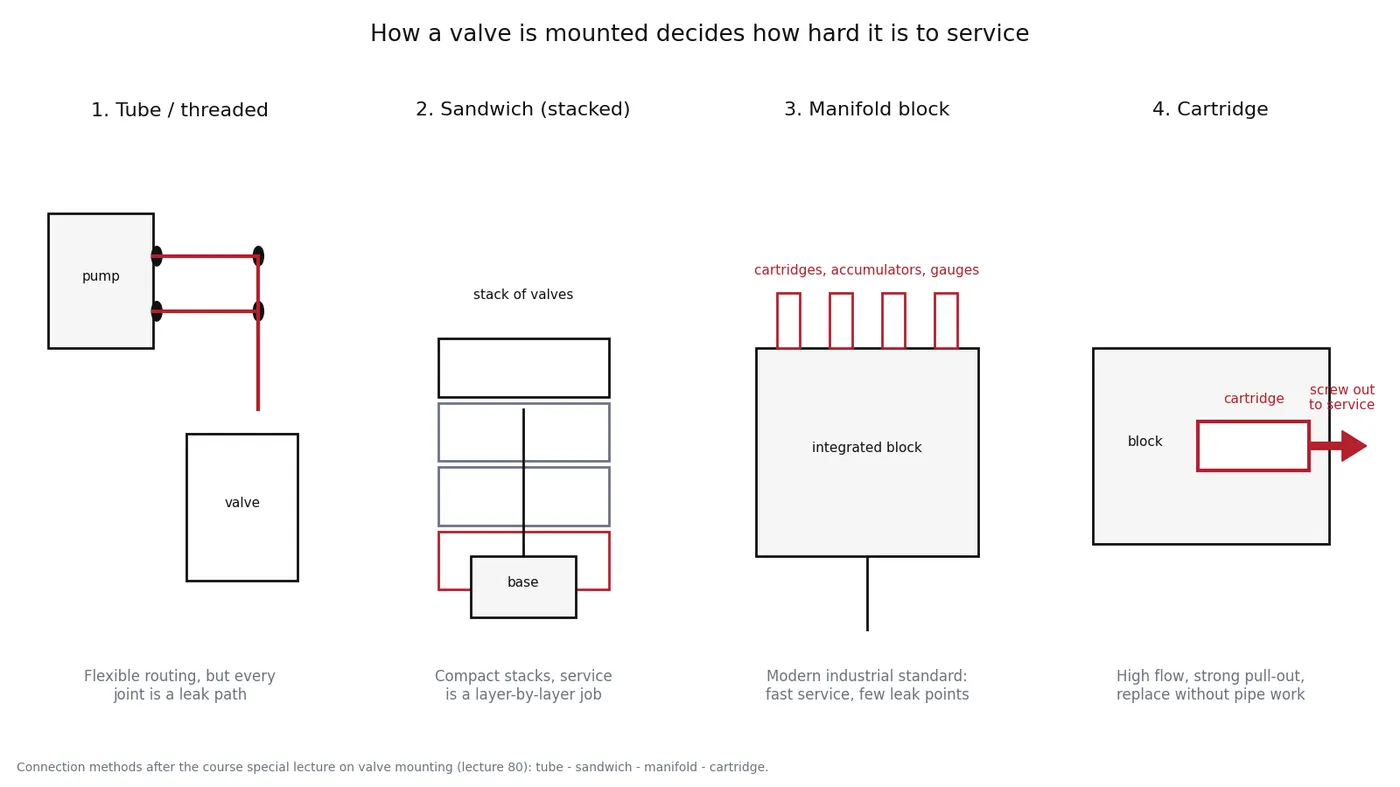
Hydraulic valve mounting has moved through four generations, and each step traded a little flexibility for fewer leak points and faster service:
- Tube and threaded connections. Every valve is piped individually. Routing is flexible and it is how most mobile machines still connect their main control valve, but every joint is a potential leak and every repair involves opening pipe work.
- Sandwich (stacked) plates. Valves stack on a common base, with internal passages carrying pressure and return. Compact and modular, but servicing a valve in the middle of the stack means taking the stack apart.
- Manifold blocks. The block is the circuit: passages are drilled into one piece of metal and cartridges, accumulators, gauges and filters mount onto it. This is the modern standard for industrial hydraulics because it removes most external joints.
- Cartridge valves. A complete valve screws into a cavity. High flow capacity, strong pull-out strength, and replacement without touching pipe work - the reason they dominate new designs.
What each style costs you in the field
| Mounting | Strength | Where it hurts | Typical use |
|---|---|---|---|
| Tube / threaded | Flexible routing, easy to modify | Many joints, vibration loosens them, service access is poor | Mobile main control valves, pilot lines |
| Sandwich | Compact, standard interfaces | A deep stack must be split to reach one valve | Industrial power units, machine tools |
| Manifold block | Few external joints, short pipe runs, easy integration | Custom block, long lead time, machining cost | Industrial systems, test rigs, power units |
| Cartridge | High flow in a small envelope, quick replacement | Cavity tolerance is critical; a scored cavity leaks | Modern mobile and industrial designs |
Why the manifold won
Three reasons, all of them practical. First, leak points: a manifold replaces a dozen flanged and threaded joints with machined passages. Second, service time: a cartridge can be unscrewed and replaced in minutes, while a piped valve needs the circuit opened and bled. Third, integration: an accumulator, a pressure gauge, a filter and four cartridges can share one block, which shortens the circuit and reduces the oil volume that has to be pressurised.
For a machine owner the consequence is simple: on a manifold design, a slow function is more likely to be one cartridge than a circuit-wide fault. That is a cheaper diagnosis.
Interfaces are where spare parts live
Whatever the mounting style, what we sell is usually the part on the interface: the valve plate inside the pump, the regulator spool in the control block, the O-ring and bonded washer that seal a port, a seal kit for a cartridge cavity.
Which is why port standards matter as much as flow ratings. Two ports can look identical and take an ISO 725 threaded stud with an O-ring, or an SAE J1926 port with a different thread and seal face. Fitting the wrong one does not fail slowly - it fails at first pressure. Our reference page lists the standards we check against, and we ask for the nameplate or a photograph of the port whenever a customer is unsure.
Before you order a valve or a seal kit
- Mounting type - tube, sandwich, manifold cavity or cartridge; cavity numbers for cartridges.
- Port standard and thread - ISO 725 / SAE J1926 / metric, and the seal type: O-ring boss, bonded washer or flat face.
- Pressure and flow at the valve, not just the system maximum.
- Spool function and centre condition - closed, open, tandem, float - because two valves that look the same outside behave differently.
- Torque figures for the cartridge or the flange bolts: under-torque leaks, over-torque cracks.
Send us a photograph of the interface and the nameplate, and we will confirm the mating part before it ships. That single step prevents most of the "it does not fit" cases we see.
Related reading: references and standards we check, spool lap and metering, and the parts library.