
Testing is the foundation, not the paperwork
The most experienced voice in our training material states it without decoration: testing is the foundation of hydraulic engineering, and the classic example is a start-up pressure spike that burst a hose and damaged a pump. Nobody designed that spike in; it was found, quantified and then designed out. Without a measurement, there is nothing to compare against and nothing to improve.
The same discipline separates a diagnosis from an opinion on a working machine. "It feels weak" cannot be settled by discussion; a case drain flow, a standby pressure and a cycle time can.
What simulation gets right, and what it cannot
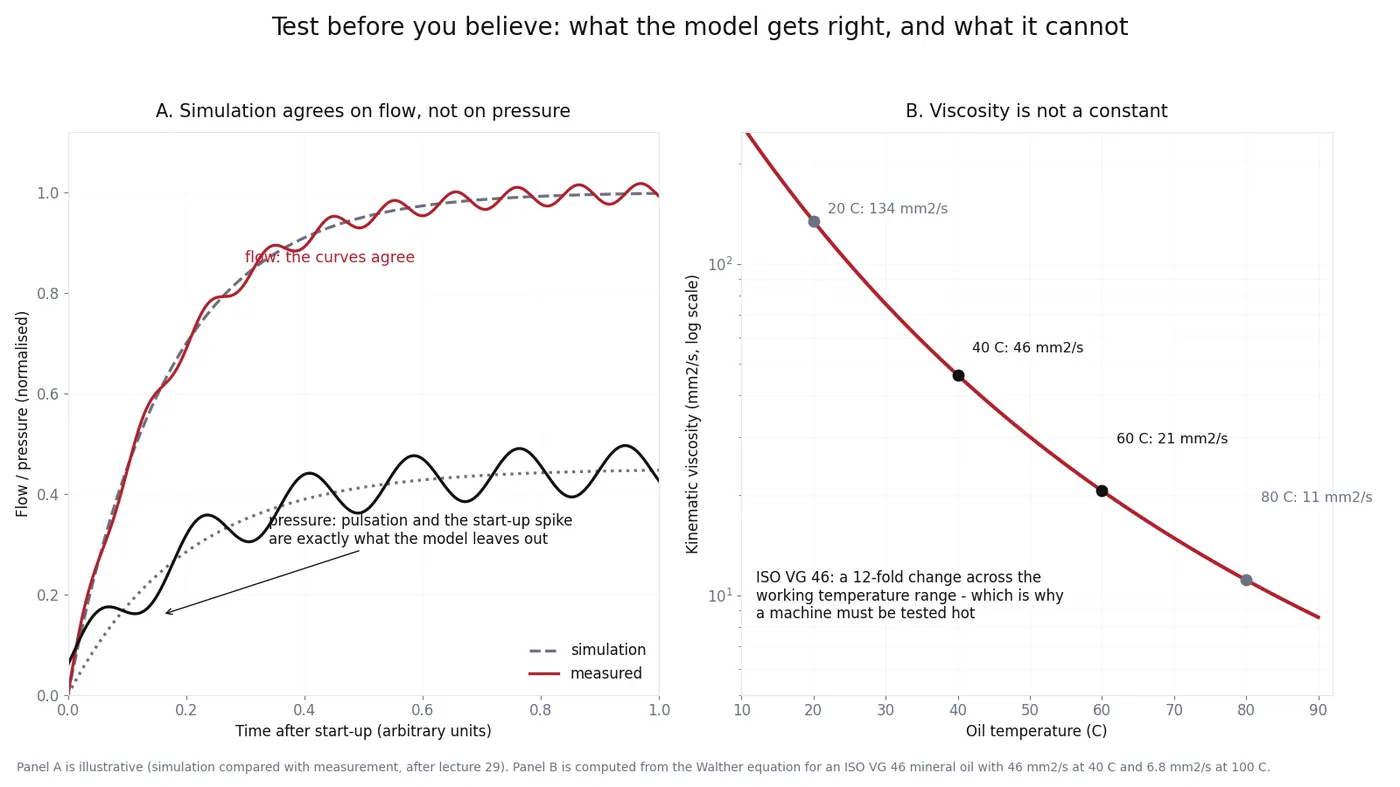
When simulation is compared with a real circuit, the honest result is this: flow agrees well, pressure deviates. Pulsation, pressure transients and unmodelled dynamics live in the pressure signal, and they are exactly the parts that damage hardware. Two assumptions deserve particular suspicion:
- Force equals pressure times area. That is true only if the pressure is the same across the whole area. It is a good approximation, not a law - and the difference is precisely where spikes hide.
- Viscosity is a constant. It is not. Flow through a given clearance follows viscosity, and viscosity follows temperature - which is why a machine tested cold tells you very little about the same machine after two hours of work.
A test plan an owner can actually run
| Reading | How and when | What it settles |
|---|---|---|
| Case drain flow | Hot, at working pressure, one minute into a container | Condition of the rotating group; trend over months |
| Standby / cutoff pressure | Gauge at the pump outlet, functions neutral, oil hot | Regulator setting and response |
| Working pressure at the duty | During real work, not against the relief | Whether the machine is matched to the job |
| Cycle time, cold and hot | Same function, same load, twice | Temperature-dependent loss: leakage or viscosity |
| Oil temperature after one hour | Simple gauge in the tank | The energy story: where the heat comes from |
| Peak pressure at start-up | Peak-hold gauge or logger on the pressure line | Whether something is being hammered every morning |
What the numbers can and cannot prove
A test plan is not a verdict machine. Flow at the relief tells you whether delivery is below specification; it does not by itself tell you whether the pump or the relief is responsible. That is why the readings are read as a pattern: everything slow points upstream of the valve, one function slow points at the valve or the cylinder, and performance that decays with temperature points at clearances. This is the same logic as our diagnosis pages, and it is why we ask for numbers rather than adjectives.
The habit worth copying
The maintenance philosophy that goes with all of this is short: move from repairing after failure to measuring before failure. Trend the case drain, sample the oil, note the cycle times at the start and end of a shift. Three numbers, taken quarterly, will tell you more about a machine than any inspection with the machine switched off - and they cost an hour a year.
Related reading: measure before you replace, the case drain test, and cleanliness targets.